Trump-Merz Tariff Summit: What a 15% “Global Baseline” Could Mean for German Automakers and U.S. Buyers
By InnoGazette Editorial Team | Scenario Analysis | March 2026
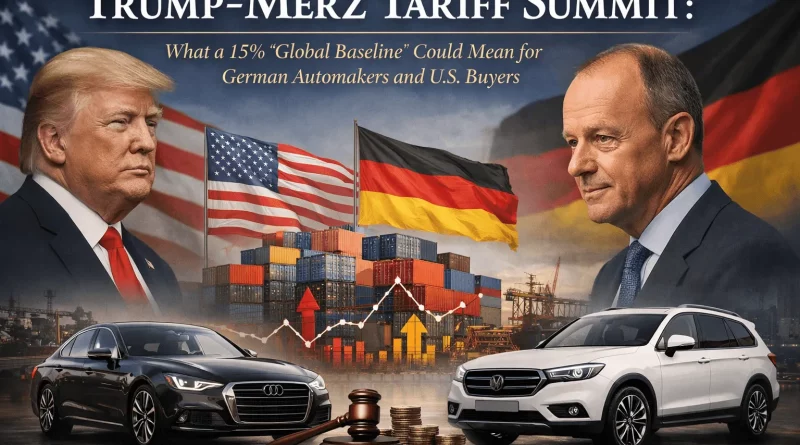
Imagine it s mid?March 2026. German Chancellor Friedrich Merz walks up the White House driveway for a meeting that could redefine transatlantic trade at least for cars and trucks. Inside, President Donald Trump is selling a simple idea with very complicated consequences: a global baseline tariff in the 10 20% range on most imports, including vehicles and parts, kept in place for now while the U.S. hammers out country?by?country deals.
No official transcript says 15% for about five months. That line doesn t exist in any real-world communiqu . But as a thought experiment, let s assume the summit produces a tacit understanding:
- The U.S. will hold a mid?teens global tariff baseline on autos and parts for a few months.
- During that window, Washington and Berlin/Brussels will negotiate specific arrangements for EU U.S. auto trade potentially including tariff reductions or quotas for European brands that increase U.S. investment and sourcing.
What would that mean for BMW, Mercedes, VW, Stellantis, U.S. dealers, and American buyers? And how would it play inside Germany, where exports and jobs still hinge heavily on the U.S. market?
Why Germany Cares So Much About a Baseline Tariff
For Germany, a U.S. tariff baseline whether 10%, 15%, or 20% is not an abstract number. It directly hits three of its most important export pillars: Premium vehicles (BMW, Mercedes-Benz, Audi, Porsche), high-end components, and EV technology.
A mid?teens blanket tariff on finished vehicles shipped from Europe to the U.S. would erode the pricing power of German luxury brands, force them to choose between eating margin or raising prices, and turn U.S. plants in the South (BMW Spartanburg, Mercedes Alabama, VW Chattanooga) into strategic lifeboats.
What Trump Would Want in Return
On the U.S. side, the political calculus in this scenario is equally straightforward. A president running on America First, Again doesn t offer tariff relief for free. To justify any carve?outs or reductions for German autos, Trump would almost certainly demand visible, countable wins: More U.S. investment and jobs, commitments on sourcing, and perhaps concessions on other fronts.
German Automakers: Between Spartanburg and Stuttgart
German carmakers already saw this movie once during Trump s first term. They responded by doubling down on U.S. manufacturing. In the new hypothetical scenario, the logic intensifies:
U.S. plants become even more critical
Vehicles built in the U.S. can be shielded from a global baseline tariff and marketed as American-built to blunt political backlash. High-volume crossovers and SUVs for the U.S. market are increasingly designed around U.S. assembly from the start.
EU plants face tough portfolio decisions
Low-margin models or ones with overlapping North American capacity become candidates for production cuts or relocation. Higher-end, lower-volume vehicles might absorb tariffs through pricing because wealthy buyers are less price-sensitive but not indefinitely.
Protect Your Investment
Whether your German luxury car is built in Stuttgart or Spartanburg, keeping the paint pristine preserves value. Chemical Guys HydroSlick offers ceramic protection at home.

What This Means for the U.S. Auto Market
From a U.S. consumer and dealer perspective, a hypothetical Trump Merz tariff framework has mixed implications.
Short-Term: Higher Prices, Less Choice
If a baseline tariff remains in place for several months while negotiations drag on, import-heavy segments could face price increases or thinner inventories. Dealers who rely heavily on imported German metal may see higher MSRPs and longer waits. Some buyers may trade down, while others delay purchases.
Medium-Term: More German Badges on U.S.-Built Vehicles
If the summit leads to a deal where tariffs are reduced in exchange for more local content, you d likely see more German-branded vehicles built in U.S. plants. For U.S. buyers, that could mean slightly better price stability on locally-built German models, but the era of cheap premium imports would move further into the rear-view mirror.
Why the 15% for Five Months Line Is Misleading in Real Life
Your prompt rightly points out that no such quote actually exists in the real news record. In reality, even if Trump informally told Merz something like we ll hold around 10 20% while we talk, you d expect ambiguity in the public language. Trade policy is now an ongoing negotiation process, not a settled backdrop.
How a Baseline Tariff Reshapes German Brand Strategies
BMW: Spartanburg as the Lifeboat
BMW already uses its South Carolina plant as a global export hub for SUVs. Under a mid?teens tariff baseline, Spartanburg becomes even more central. More of BMW s U.S. volume is locked into U.S. assembly, while European plants feel the squeeze.
Mercedes-Benz: Alabama, Europe, and Mexico Triangulation
Under a sustained tariff baseline, Alabama takes on a bigger share of U.S. volume. GLE and GLS become the backbone of U.S. Mercedes sales, increasingly localized. Germany keeps the top tier (S-Class, Maybach), but volumes stay modest.
Luxury Interior Care
German luxury interiors demand the best. Maintain your leather seats with Meguiar’s Gold Class Rich Leather Spray.

VW Group: VW, Audi, Porsche Balancing Act
Volkswagen leans more heavily on its U.S. plant for volume SUVs. Audi may prioritize higher-margin models and U.S. assembly. Porsche can likely absorb more of the tariff due to pricing power but might rethink entry-level trims.
EVs and Hybrids: Where Tariffs and Climate Policy Collide
A global tariff baseline combined with content-based EV incentives creates a carrot-and-stick approach. For German brands, this drives them to localize more EV and battery production in the U.S. or North America and prioritize EV and PHEV models that can be built on flexible platforms.
The Bigger Picture: Differentiating Allies from Rivals
One of the most important meta-effects of a Trump Merz-style summit is the clear separation of allies and rivals in trade policy. China faces the harshest treatment, while allies like Germany may find negotiated pathways to relief. For German automakers, that means the U.S. market remains worth the trouble, but only if they adapt quickly.