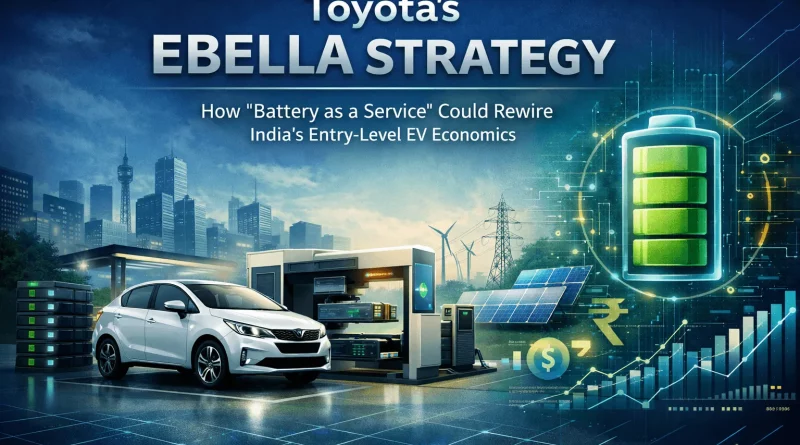
Toyota’s Ebella Strategy: How “Battery as a Service” Could Rewire India’s Entry-Level EV Economics
By InnoGazette Editorial Team | March 13, 2026
When Toyota Kirloskar Motor (TKM) officially launched the all?electric Urban Cruiser Ebella in India in January 2026, two elements stood out immediately: this was Toyota’s first battery?electric vehicle for the Indian market, and it came bundled with a Battery?as?a?Service (BaaS) promise alongside an 8?year battery warranty and a 60% assured buyback program.
On March 4, 2026, however, the story deepened. Industry sources and dealer?side documents circulating online suggested leaked BaaS pricing structures for the Urban Cruiser Ebella, indicating how Toyota actually intends to use battery subscription models to lower the upfront cost of ownership and compete head?on with both ICE compact SUVs and early EV rivals. As of March 13, those detailed tariffs have not been published on Toyota’s official channels, but enough pieces exist—across Toyota Kirloskar’s launch communications and credible Indian auto media—to construct a clear picture of the “Ebella Strategy” and why it matters.
This article focuses on what is officially confirmed, what can be inferred from reliable reporting, and where the March 4 leak fits into that context.
1. Urban Cruiser Ebella: Toyota’s First BEV for India
1.1 Official Product Positioning
Toyota Kirloskar describes the Urban Cruiser Ebella as its entry into India’s BEV segment, built on an “URBAN TECH” theme that blends SUV stance with a modern electric powertrain.
Key official specs and positioning:
- Platform and segment: Compact SUV, co?developed with Maruti Suzuki (essentially a rebadged version of the forthcoming e?Vitara). Targets the heart of India’s mass?market compact SUV space where Creta, Grand Vitara, and MG ZS EV play.
- Battery and range: Two battery options: 49 kWh and 61 kWh. Larger 61 kWh pack: up to 543 km ARAI?certified range on a single charge (front?wheel?drive, single?motor configuration).
- Performance (India spec): 49 kWh: around 142 bhp (approximate figures from launch coverage). 61 kWh: up to 172 bhp and 189 Nm, front?wheel drive only for India; global all?wheel drive remains overseas.
- Interior and features: Dual?tone premium cabin, soft?touch surfaces, sliding rear bench, 40:20:40 split seats, ambient lighting, panoramic roof. Features include ventilated front seats, wireless charging, JBL audio, multiple USB ports, air purifier, and a modern infotainment suite.
- Safety and ADAS: Seven airbags, VSC, ABS, EBD, ESP, high?tensile body. Level 2 ADAS on higher trims: automatic emergency braking, lane keep assist, blind spot monitoring, rear cross?traffic alert, adaptive cruise control.
On pricing, Toyota’s official release explicitly says bookings open from January 20, 2026, with price announcement “shortly”. Since then, multiple Indian outlets have converged on an expected on?road band of roughly ?19.06–24.42 lakh, corresponding to about ?19–24 lakh for the mainstream trims, positioning the Ebella directly against mid?to?upper compact SUVs.
2. The Core of the “Ebella Strategy”: Ownership, Not Just Hardware
2.1 Ownership Pillars Officially Confirmed
Toyota has clearly framed the Urban Cruiser Ebella not as a standalone EV, but as a complete ownership ecosystem designed to reduce anxiety around cost, service, and resale.
The official pillars include:
- 8?year battery warranty: Standard long?term coverage on the traction battery, matching or exceeding many rivals.
- Assured buyback: Up to 60% assured buyback after a defined period, signaling residual value confidence.
- Battery?as?a?Service (BaaS) option: Explicitly referenced in Toyota’s launch press release as “Battery?as?a?Service options.” Indian launch coverage echoes this, describing BaaS as a battery rental program to lower the initial acquisition cost.
- Service and charging ecosystem: Over 500 BEV?enabled service touchpoints equipped with EV diagnostics and infrastructure. 2,500+ BEV master technicians trained, with 45?minute express maintenance offered across all outlets. Partnerships with ChargeZone and Jio?bp for public charging, plus home charging solutions.
Toyota’s own language emphasizes reassurance rather than bleeding?edge tech: “Our focus has been to reduce anxiety around service, charging, and resale by building a complete ownership ecosystem.” The BaaS element is therefore one part of a larger Ebella Strategy aimed at lowering perceived risk for first?time EV buyers in India.
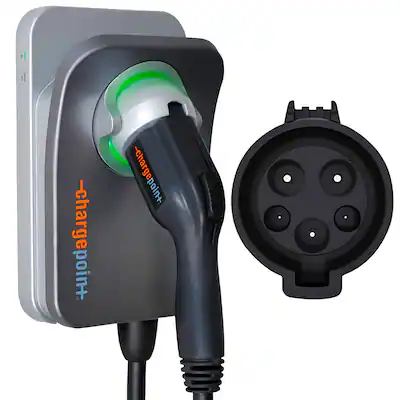
Charge at Home
Maximize your Ebella’s convenience with a reliable home charger. The ChargePoint Home Flex works with all EVs and adjusts amperage to fit your panel.
3. Battery?as?a?Service for Ebella: What’s Known, What’s Leaked
3.1 Confirmed Concept, Unpublished Tariff
Unlike Nio in China, which publishes detailed Battery?as?a?Service contract terms, Toyota has not yet put its Ebella BaaS pricing matrix on its Indian website. The official site and launch communications instead direct customers to dealerships for specifics: “For detailed information on the Assured Buyback and Battery as a Service schemes, we recommend visiting your nearest Toyota dealership.”
From official and reputable sources we can say:
- BaaS is real and active, not hypothetical.
- It allows buyers to exclude the battery from the vehicle’s purchase price, replacing it with an ongoing subscription payment.
- The explicit intent is to lower the initial on?road cost, addressing one of the biggest barriers to EV adoption in India.
3.2 What the March 4 “Leaked Pricing” Likely Represents
As of March 13, 2026, there is no official PDF or press note from Toyota Kirloskar Motor publishing the per?month or per?km tariffs for Urban Cruiser Ebella’s BaaS plan. The March 4 leak being discussed in industry circles appears to be a set of dealer?facing communication slides or an internal note outlining:
- The base ex?showroom price of Ebella without battery, and
- A menu of subscription plans for the 49 kWh and 61 kWh packs (likely differentiated by mileage tier and duration).
This follows the pattern already visible with competing programs. For example, MG’s BaaS?style approach in India for some EVs uses per?km pricing starting around ?3.5 per km, separating vehicle and battery cost and meaningfully cutting the vehicle’s upfront price. Reports on Suzuki’s e?Vitara suggest a similar pay?per?use or subscription structure.
While the rumored Ebella numbers circulating on social media look directionally similar—with substantial upfront price reductions (in some cases 30–40%) offset by a recurring battery fee—those exact figures cannot be verified against Toyota’s own channels yet.
The professionally safe framing, as of March 13, is therefore:
- Toyota has a BaaS scheme for Ebella.
- The scheme is designed to cut upfront price by excluding the traction battery from the initial invoice.
- Detailed pricing is being communicated via dealers, not centrally published online yet, so any precise rupee amounts or per?km rates should still be treated as provisional or leaked, not official.
4. How BaaS Changes the Economics for the Urban Cruiser Ebella
4.1 Upfront Cost vs Lifetime Cost
Typical estimates from Indian outlets place the Urban Cruiser Ebella’s all?in, battery?included on?road price between roughly ?19.06–24.42 lakh, depending on variant and tax region.
Under a potential BaaS model (for illustration, not quoting leaked numbers):
- The vehicle shell (excluding battery) might be priced closer to the ?17–18 lakh band for the base 49 kWh variant and ?19–21 lakh for the 61 kWh mid?trim, bringing it much closer to comparable ICE compact SUVs on sticker price.
- The buyer then signs a battery subscription contract, paying either a fixed monthly fee, or a per?kilometre fee, similar to MG’s cited ?3.5/km battery rental.
For many urban Indian customers, particularly those with predictable annual mileage, this structure can reduce the psychological shock of a high EV sticker price, frame the battery as an operating expense (analogous to fuel) rather than a sunk capital item, and mitigate degradation anxiety since a rental battery can in principle be replaced/managed by the OEM under contract terms.
4.2 Residual Value and Risk Transfer
The 60% assured buyback and 8?year warranty complement BaaS by shifting key risks:
- Residual value risk (what is my EV worth in 5–8 years?) is partly taken on by Toyota through the buyback program.
- Battery degradation risk is reduced both by the warranty and by the possibility (depending on contract) of battery replacement within the BaaS framework.
For Toyota, BaaS and buyback create a predictable flow of used batteries and vehicles back into its control, potentially feeding remanufacturing, second?life stationary storage, or certified pre?owned EV channels.
5. Strategic Rationale: Why Toyota Is Experimenting with BaaS in India
5.1 A Market That Demands Frugality and Flexibility
India’s EV market remains small but fast?growing, with particular sensitivities:
- Price elasticity is high; even a ?1–2 lakh difference can sway purchasing decisions.
- Charging infrastructure is uneven, though improving, especially in Tier?1 and Tier?2 cities.
- Policy incentivizes EVs but also, in some states, strongly supports hybrids—an area where Toyota has deep experience.
Toyota executives have argued for years that strong hybrids and diverse powertrains are essential stepping stones for India. The Ebella Strategy fits that philosophy: it is less about an all?in bet on BEVs and more about de?risking the idea of owning one.
BaaS for Ebella lets Toyota compete with rivals like MG and Suzuki that already use battery rental schemes, preserve its brand promise of durability by removing the battery as a perceived “single point of failure” cost, and test a model that could later be applied to other markets or segments, if successful.
5.2 Leveraging Partnerships and Ecosystem Investments
The strategy also capitalizes on ecosystem moves:
- Charging partnerships with ChargeZone and Jio?bp reduce the need for Toyota to build every kilowatt of infrastructure itself.
- The BEV service network (500+ touchpoints, 2,500 trained technicians) creates a service moat that is hard for new entrants to match quickly.
By pairing BaaS with this ecosystem, Toyota increases the chance that an Ebella buyer’s experience—from purchase to maintenance to resale—feels cohesive and lower?risk.
Keep it Clean
New car or old, keeping it clean maintains value. The Chemical Guys Arsenal Builder Kit has everything you need for a professional detail.

6. How the Ebella BaaS Compares to Nio and Others
It is tempting to view Toyota’s move as directly copying Nio’s Chinese playbook, and indeed some coverage phrases it exactly that way: “Toyota copies Nio’s BaaS for India EV debut.” But there are key differences:
- No battery swap network (yet): Nio’s BaaS is deeply integrated with a vast battery?swapping infrastructure. Toyota, in India, is focusing on fixed pack rental, not automated swapping, relying instead on public and home charging.
- Focus on upfront price reduction, not tech showcase: Nio’s model began as a tech?forward solution to charging downtime. Toyota’s emphasis in India is on affordability and certainty, not on cutting?edge swapping.
- Competitive landscape: In India, Toyota is entering a space where MG, Suzuki and others already test similar models. BaaS is as much defensive as it is innovative.
The Ebella Strategy is therefore best seen as localized adaptation: borrowing the economic logic of separating vehicle and battery, but tailoring it to India’s price?sensitive, infrastructure?constrained conditions.
7. What the March 4 Leak Tells Us—And What It Doesn’t
The March 4, 2026 leaked “Ebella BaaS pricing” material should be understood with the following caveats:
- It appears consistent with Toyota’s publicly stated goals and with the broader competitive context for EVs in India.
- It likely reflects dealer or internal planning documents, not final, centrally published tariff tables.
- Until Toyota publishes a formal BaaS pricing schedule, any precise numbers remain unofficial, even if they ultimately prove accurate.
From a rigorous standpoint as of March 13: It is correct to say Toyota is deploying BaaS on the Urban Cruiser Ebella to lower upfront costs, alongside 8?year battery warranty and 60% assured buyback. It is not yet correct to treat specific rupee figures from the March 4 leak as confirmed, unless and until they appear in Toyota Kirloskar’s official materials.
8. Conclusion: Ebella as a Testbed for New EV Economics
The Urban Cruiser Ebella is more than Toyota’s first BEV for India; it is a testbed for a new way of structuring EV ownership:
- Technically, it delivers competitive range (up to 543 km ARAI), robust safety, and a feature?rich compact SUV package.
- Commercially, it pairs that package with BaaS, long battery warranty, and assured buyback, directly targeting cost anxiety and resale fear.
- Strategically, it positions Toyota not as a reluctant latecomer, but as a cautious, ecosystem?focused player using flexible financial architecture to make EVs feel less risky.
The leaked March 4 BaaS pricing grids, while not yet official, underscore how central these ownership levers are to the Ebella Strategy. They suggest a future in which many Indian EV buyers may stop asking “How much does the battery cost?” and instead ask “What’s my monthly energy and battery bill?”—a shift in mindset that could prove as important as any kilowatt?hour figure in moving the market forward.