Stellantis’ 22.2 Billion EV Write-Down: Pivoting to Hurricane I6 and Hybrids for 2027 Amid Market Reset
By InnoGazette Editorial Team | February 20, 2026
In a seismic shift that’s rippling through the automotive world, Stellantis the global giant behind Jeep, Ram, Dodge, Chrysler, Peugeot, and Fiat has taken a staggering 22.2 billion ($26 billion) write-down on its electric vehicle (EV) programs. Announced earlier this month, this move admits what many industry insiders have whispered for months: the company wildly overestimated EV demand. Instead of doubling down on battery-powered dreams, Stellantis is rebalancing toward profitable internal combustion engine (ICE) and hybrid powertrains, with the spotlight firmly on its potent Hurricane inline-6 (I6) engine and revolutionary “Ramcharger” technology for the 2027 Ram and Jeep lineup.
This isn’t just accounting sleight-of-hand; it’s a candid “strategic reset” from CEO Antonio Filosa, who called out “overly optimistic” assumptions about electrification’s pace. As U.S. EV sales slump February 2026 retail share dipped to 6.6%, down 1.8 points year-over-year Stellantis is betting big on customer realities over regulatory mandates. For enthusiasts craving power and truck buyers prioritizing range and affordability, this pivot promises a high-tech bridge to the future. Let’s dive deep into why this pivot happened, what the Hurricane brings to Ram and Jeep, and how it signals a broader industry rethink.
The 22.2B Bombshell: What Sparked Stellantis’ EV Reckoning?
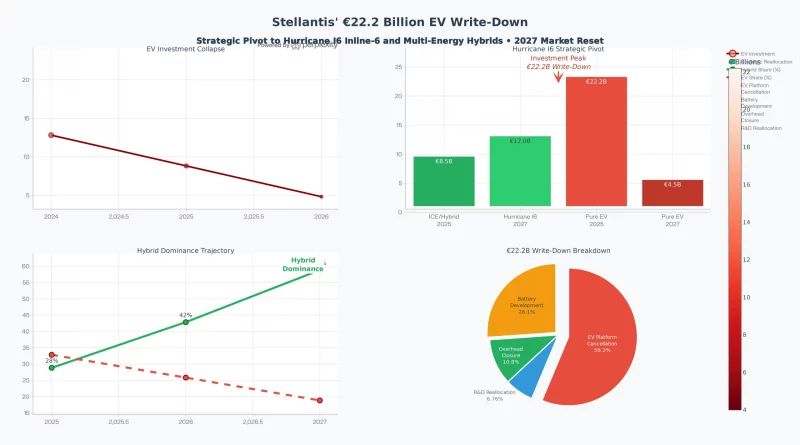
Picture this: It’s early February 2026, and Stellantis drops a press release that tanks its shares 15% in a day. The culprit? A massive 22.2 billion charge in H2 2025, covering canceled EV projects, supplier contract busts, and restructuring costs. This dwarfs similar hits from Ford and GM, underscoring Stellantis’ aggressive EV push under former CEO Carlos Tavares.
Back in 2022, Tavares vowed 100% BEV sales in Europe and 50% in the U.S. by 2030. Billions poured into platforms like STLA Large and battery joint ventures, including a Leapmotor stake and a now-sold 49% in a U.S. plant with LG Energy Solution. But reality bit hard. Global EV adoption stalled amid high interest rates, charging woes, and sticker shock U.S. incentives hit $3,293 per vehicle last month alone.
“We overestimated the pace of the energy transition,” Filosa admitted on the earnings call. Factors included softening demand (Europe’s EV share flatlined at 14%), subsidy cuts, and competition from Tesla and BYD hybrids. Stellantis’ U.S. sales plunged 20% in 2025, with Jeep Recon EVs facing significant delays. The write-down clears the deck: no more dividend for 2026, 5 billion in hybrid bonds, and a laser focus on cash flow.
This reset echoes peers: Ford‘s hybrids now outsell EVs 3:1, GM reintroduces PHEVs by 2027. Stellantis plans “multi-energy” lines for ICE, hybrid, or EV on the same floor flexible manufacturing for a hybrid bridge strategy.
The “Secret Weapon”: STLA Frame Platform
Crucially, Stellantis has an ace up its sleeve that competitors lack: the STLA Frame platform. Unlike GM’s Ultium (dedicated EV), STLA Frame was designed from day one to accommodate BEV, REEV (Range Extended EV), and pure ICE powertrains. This flexibility allows Stellantis to pivot production on the fly swapping battery packs for gas tanks on the same assembly line saving billions in potential factory retooling costs. This architecture underpins the 2025/2026 Ram 1500 and upcoming Jeep Wagoneer models, making the pivot mechanically seamless.
Hurricane I6: The Heart of Stellantis’ ICE Revival
Enter the Hurricane: Stellantis’ twin-turbo 3.0-liter inline-6, unveiled in 2022 as the Hemi V8’s spiritual successor. No longer a side note, it’s central to the 2027 Ram and Jeep strategy, delivering V8-like grunt with better efficiency. Why I6? Straight-six balance rivals V8 smoothness, twin turbos spool instant torque, and it’s cheaper to electrify later.
Key Specs at a Glance:
| Variant | Horsepower | Torque (lb-ft) | Boost | Fuel Req. | Redline |
|---|---|---|---|---|---|
| Standard Output (SO) | 420 | 469 | 22 psi | Regular | 5,800 RPM |
| High Output (HO) | 540 | 521 | 26 psi | Premium | 6,100 RPM |
The Hurricane’s plasma-sprayed bores cut friction 10x over iron liners, enabling 13-15% CO2 savings vs. the 5.7L Hemi. Direct injection at 350 bar, chain-driven cams, and a flat torque curve from 2,850 RPM make it a torque monster for towing crucial for Ram faithful.
Already proven in the Jeep Wagoneer and 2025 Ram 1500, it’s set for broader 2027 duty. For enthusiasts, Mopar is even offering the “Hurricane Crate Engine” (Cat 1 and Cat 3 variants) for restomodders, proving Stellantis is committed to internal combustion performance for the long haul.
2027 Ram 1500: Refining the Workhorse & The Rise of the Ramcharger
The Ram 1500, America’s torque king, continues its evolution for 2027. While the Hurricane I6 became standard in 2025, the 2027 strategy focuses on optimizing trims to recapture market share. Expect the SO engine in base Tradesman models and the HO in Limited/Tungsten luxo-haulers. Peak output of 540 hp eclipses the old 5.7L’s 395 hp while sipping less fuel.
However, the real game-changer is the 2026/2027 Ram 1500 Ramcharger. This “Range Extended Electric Vehicle” (REEV) features a massive 92 kWh battery for 145 miles of pure electric driving, paired with a V6 Pentastar on-board generator.
- Total Range: 690 miles.
- Towing: 14,000 lbs (best-in-class).
- Drive Modes: Eco, E-Save, and Battery Hold allow tailored energy use.
- Why it wins: It solves the #1 truck buyer complaint towing range anxiety while still offering EV daily driving. This “no compromise” truck is expected to outsell the pure-electric Ram 1500 REV by 4:1.
Refreshes include air suspension tweaks for better payload (2,300+ lbs?), coil-spring rear for off-road RHO variant, and “multi-energy” flexibility. Pricing? Base around $40K, HO trims $60K+, undercutting Rivian R1T’s $70K EV tab. With U.S. sales soft (Feb total 1.183M units, -3.8% YoY), Hurricane Ram aims to reclaim 10%+ market share.
Jeep’s 2027 Lineup: Hurricane Fuels Adventure Redefined
Jeep, Stellantis’ profit engine, pivots hardest. The Wagoneer/Grand Wagoneer already rely on the Hurricane, and 2027 brings it to the Grand Cherokee L (HO for 500+ hp). The previously announced Wagoneer S PHEV delay has been scrapped in favor of accelerating hybrid integration.
Gladiator 4xe Canceled: In a surprise move reflecting the new austerity, the much-anticipated Jeep Gladiator 4xe has been canceled. Stellantis confirmed the midsize truck platform will instead focus on V6 (and potentially V8) variants to maximize margins, abandoning the complex plug-in integration for this lower-volume model.
Wrangler Strategy: While rumors of a Hurricane I6 swap persist, the current JL platform’s engine bay length likely precludes the inline-6 without major modification. Instead, expect the 2.0T and 3.6L V6 to soldier on, potentially with updated eTorque systems, until the next-generation (JM) Wrangler arrives.
Recon Delayed: The Jeep Recon, once the poster child for Jeep‘s EV future, is seeing significant delays. Built on STLA Large, it is likely being re-engineered to support a hybrid “Multi-Energy” variant to ensure wider appeal in a cooling EV market.
This aligns with Jeep‘s “freedom of choice” mantra ICE and Hybrid for trails where chargers fear to tread. U.S. Supreme Court rulings challenging broad mandates further help, potentially lowering compliance costs for Hurricane assembly at Saltillo.
Financial Context: The Economics of Emissions
Why pivot back to gas? Analysts note a stark reality: Stellantis needs only ~15-20% EV mix in the U.S. to remain profitable, even with CAFE fines. Paying penalties on highly profitable Hurricane-powered Ram trucks ($15k+ profit per unit) is often cheaper than losing $10k on every pure EV sold. This “profit over compliance” strategy defines the 2027 roadmap.
Broader Implications: Industry Reset or EV Winter?
Stellantis’ pivot spotlights a market reset. EV slowdown? Yes global sales growth halved to 20% in 2025. Hybrids surge: Toyota‘s RAV4 outsells Tesla Model Y. Stellantis eyes $13B U.S. investment for Hurricane lines, humanoid robots aiding factories.
Critics cry “greenwashing,” but data backs hybrids: Toyota‘s 50 mpg Prius crushes EV TCO in rural U.S. Stellantis’ Dare Forward 2030 update (Feb 26) promises EV tech but demand-led.
Pros of Pivot:
- Profitability: ICE/hybrids 20% margins vs. EV losses.
- Customer Fit: 80% U.S. trucks/SUVs want range >400 miles (Ramcharger solves this).
- Flexibility: Same lines build all powertrains via STLA Frame.
Cons:
- Regulatory Heat: EU 2035 ICE ban looms; CAFE fines possible.
- Investor Jitters: Shares down 25% YTD.
- Green Cred: CO2 targets slip without BEVs.
Competitors react: Honda‘s flexible lines, Acura Integra focus; BYD‘s $3B Mexico Shark hybrid plant.
Expert Voices and Owner Reactions
“Stellantis bet the farm on EVs too soon smart to pivot while solvent,” says UM-Flint economist Chris Douglas. Ram forums buzz: “Hurricane HO in 1500 is a beast tows better than the Hemi.” Jeep purists cheer: “Finally prioritizing power over plugs.”
Antonio Filosa: “Pace dictated by demand, not command.” Wall Street mixed: Barclays upgrades to “buy” on hybrid upside.
The Road Ahead for Stellantis
By 2027, Hurricane I6 and Ramcharger REEV will anchor the Ram/Jeep revival, hybrids will bridge to affordable EVs (sub-$30K by 2030?), and the portfolio will streamline around profitable core models. Feb 26 earnings will detail: expect 2026 net profit rebound, 5-7% sales growth.
This 22.2B write-down? Painful tuition for listening to buyers. In Gainesville, Florida where trucks rule it’s welcome news. Stellantis isn’t abandoning green; it’s grounding it in reality. Buckle up: Hurricane winds are blowing.
Stellantis EV Pivot FAQs
Why the huge write-down?
Canceled EV programs, supplier penalties, and gigafactory pauses 22.2B clears path for profitable ICE/hybrids.
Is Hurricane better than Hemi?
Yes: 30% more power, 15% efficiency, smoother. HO tops 540 hp.
Ram 1500 V8 gone forever?
Yes Hurricane I6 is the new standard, with Ramcharger REEV as the halo.
Impact on Jeep Wrangler?
Current JL continues with V6/2.0T; Hurricane likely waits for next-gen. Gladiator 4xe canceled.