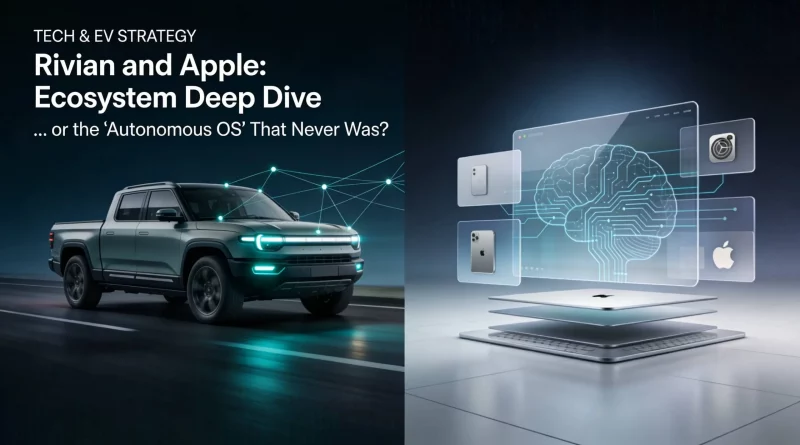
Rivian and Apple: Ecosystem Deep Dive or the “Autonomous OS” That Never Was?
By InnoGazette Editorial Team | February 23, 2026
Apple has officially walked away from building its own car but it may not be walking away from the car business at all. At the same time, Rivian is gearing up to launch its next-generation R2 and R3 models, with a brand-new software platform and a customer base that looks suspiciously like Apple s core audience.
That combination has sparked a growing wave of industry chatter: has Apple quietly pivoted from “Apple Car” hardware to becoming the brains inside Rivian s future lineup starting with R2 and R3?
There is no official announcement of a Rivian Apple “Autonomous OS” partnership today. In fact, a $5 billion joint venture between Rivian and Volkswagen Group makes a full Apple takeover structurally unlikely. But Apple s confirmed exit from EV hardware, combined with Rivian s evolving software stack and a series of deepening integrations (Car Key, Apple Watch app, Apple Music), form a plausible foundation for a unique relationship.
This article walks through what s real, what s rumored, and why Rivian remains at the center of Apple speculation despite the VW deal.
Apple Car Is Dead. The Software Ambition Isn t.
Apple s decade-long car effort Project Titan was formally shuttered in early 2024 after billions in investment, multiple strategy resets, and no production vehicle.
Key points that matter for any Rivian rumor:
- Hardware is out: Apple abandoned plans to design and manufacture its own EV, after exploring everything from traditional steering wheels to ambitious “no wheel” Level 4/5 concepts.
- Staff shifted to AI and software: Many Titan engineers were reassigned to Apple s AI and software groups, building the foundation for “Apple Intelligence” and future platform services.
- The core competency remains: Apple still has teams deeply familiar with automotive-grade compute, sensor fusion, mapping, and human machine interface challenges even if those teams no longer build a car.
That mix of skills sets up a logical new strategy: instead of competing with Tesla, Toyota, or Rivian on hardware, Apple can license and embed its software stack into other people s vehicles to own the “glass” without owning the factory.
Rivian s R2 and R3: The Perfect Canvas
While Apple was winding down hardware, Rivian was doing the opposite building out the next phase of its product roadmap.
R2: Rivian s “Mainstream” Moment
R2 is Rivian s midsize SUV, positioned below the R1S on a more affordable, high-volume platform. Highlights:
- Target 300+ miles of range in core trims.
- 0 60 mph in the mid-3-second range for top performance variants.
- Pricing aimed well below the R1S, with the goal of becoming an “affordable EV breakout” around 2026.
- Built on a new generation of Rivian s “zonal” architecture with centralized compute and updated electronics.
R3 and R3X: Smaller, Sportier, More Global
R3 and R3X are Rivian s compact crossover/hatchback entries, designed for tighter urban streets and global markets like Europe and Japan. They share the R2 platform DNA battery tech, motors, electronics but shrink the footprint and price.
Crucially, Rivian has signaled that R2 debuts “version 2.0” of its electrical architecture. This cleaner, modular software stack is exactly the sort of environment where deep third-party integration could theoretically live.
Seamless Connection
Whether you’re using Apple CarPlay or Rivian’s native interface, keep your devices powered and ready. The Anker USB C Charger ensures fast charging for all your Apple gear.

The Elephant in the Room: The Volkswagen Joint Venture
To fact-check the “Apple OS” rumor, we must address the massive deal that actually happened. In 2024/2025, Rivian and Volkswagen Group finalized a $5 billion joint venture (JV).
What the VW Deal Does:
- Co-Developed Core: Rivian and VW are co-developing the next-generation electrical architecture (SDV – Software Defined Vehicle) that will power the R2 and future VW/Audi/Scout/Porsche EVs.
- Shared “Brain”: The underlying “kernel” managing battery thermals, motor control, and ADAS (Advanced Driver Assistance Systems) is now a shared asset.
Why This Complicates an Apple Takeover:
It is highly unlikely that Volkswagen Group would allow Apple a potential data competitor to own the “Autonomous OS” layer of a platform they are paying billions to develop. VW needs this software to save its own brands; handing the keys to Apple would defeat the purpose of the JV.
However… The “Experience Layer” is Open
While VW and Rivian build the skeleton, the skin the user interface, the maps, the media is still Rivian‘s domain. This is where Apple fits in. Rivian can use the VW-backed core for safety while letting Apple dominate the user experience.
What s Official Today: Apple Already Lives Inside Rivians
Even without a hostile “Autonomous OS” takeover, Rivian offers one of the most “Apple-native” experiences on the road today.
1. Apple Wallet Car Key
Rivian has rolled out full support for Apple Car Key. R2 owners can lock, unlock, and start their vehicle using just an iPhone or Apple Watch.
- Works via NFC and Ultra Wideband (UWB) for proximity awareness (passive entry).
- Supports digital key sharing with family or friends via iMessage.
2. Native Apple Watch App
Rivian is launching a native Apple Watch app as part of its early-2026 software updates.
- Capabilities: Lock/unlock, horn/lights, and frunk opening from the wrist.
- Telemetry: Direct access to charge level and range status via Watch complications.
- Preconditioning: Remote climate control activation.
3. Apple Music & Spatial Audio
Rivian was one of the first non-CarPlay native integrations of Apple Music, complete with Dolby Atmos Spatial Audio support. This shows Rivian is willing to let Apple services shine without forcing the full CarPlay interface overlay.
These features are modest compared to a full-blown OS partnership but they show Rivian is comfortable putting Apple at the center of the ownership UX, creating a “halo effect” for iPhone users.
The Rumor: “Apple Intelligence” as a Co-Pilot?
Here s where we move from confirmed fact to industry chatter. MacRumors and other Apple-focused outlets have reported that Apple is “exploring partnerships” to bring its AI and services to market. Rivian is frequently mentioned as the most likely early partner.
The “Siri+Rivian” Concept
Instead of replacing the entire OS, the rumor suggests Apple could become the Intelligence Layer.
- Voice Command: “Hey Siri” could gain API access to vehicle functions. “Hey Siri, set Rivian suspension to Soft and navigate to the nearest fast charger.”
- Predictive Routing: Apple Maps could read real-time battery telemetry (SoC, consumption rate) to plan charging stops natively within Apple Maps, rather than relying on Rivian‘s nav.
Why this isn’t “Autonomous OS”:
Calling it an “Autonomous OS” implies Apple controls the self-driving stack. With the VW JV in place, Rivian/VW control the autonomy (perception, planning, actuation). Apple would likely control the Human-Machine Interface (HMI) related to it how the car communicates to the driver rather than the driving itself.
Enhanced Audio Experience
Enjoy Apple Music’s Spatial Audio in your Rivian? Ensure every passenger hears it clearly. The WHOOSH! Screen Cleaner Kit keeps your display pristine for controlling your playlist.

Why Rivian Makes More Sense for Apple Than a Legacy OEM
If Apple were to license deep integration, Rivian checks boxes that traditional automakers struggle with.
Software-First DNA
Rivian treats the vehicle like a modern computing platform centralized compute, OTA updates, new features delivered via software several times a year. Most legacy OEMs still juggle dozens of siloed ECUs and slow update cycles.
Demographic Overlap
Rivian s early buyers skew affluent, tech-forward, and environmentally conscious a near-perfect circle with Apple s iPhone/Mac/Vision Pro base. An Apple-enhanced Rivian is a natural upsell to that audience.
The “Anti-Tesla” Alliance
Tesla has a closed ecosystem that is actively hostile to Apple (no CarPlay, no Apple Music native integration for years). General Motors has also banned CarPlay. Rivian represents a “Switzerland” a modern EV maker that is friendly to the Apple ecosystem, making it the perfect vessel for Apple to demonstrate its in-car prowess against Tesla.
What an “Apple-Infused” Rivian OS Could Look Like
Even if no formal “OS” deal exists, it s useful to sketch what a plausible Rivian Apple software stack might look like on R2/R3, co-existing with the VW backend.
1. Deep Apple Identity
Sign in with Apple ID in the vehicle. Driver profiles sync from iCloud: Apple Music playlists, Apple Maps favorites, and even HomeKit scenes appear on the dash automatically.
2. Apple Maps + Rivian Intelligence
Apple Maps provides the base UI. Rivian layers on EV-specific data (battery temp, motor efficiency). The result is Apple Maps that “knows” it is driving a Rivian.
3. Next-Gen CarPlay?
Apple announced “Next-Gen CarPlay” years ago a system that takes over all screens, including the gauge cluster. Few automakers have adopted it (Porsche/Aston Martin dipped toes in). Rivian‘s R2 display layout is perfect for this. While Rivian has resisted CarPlay historically to own the data, a custom “Rivian Edition” of Next-Gen CarPlay could offer the best of both worlds: Rivian branding, Apple functionality.
Strategic Upside for Each Side
For Apple:
- Platform Leverage: Extends the ecosystem into vehicles without trillions of capex.
- Services Revenue: Potential for recurring revenue (Apple One Premier + Car?) just like iCloud.
- Data Flywheel: Access to anonymized driving data to improve Apple Maps.
For Rivian:
- Differentiation: “Best iPhone integration in the EV market” is a powerful sales pitch against Tesla and the CarPlay-banning GM.
- Trust: A huge portion of buyers already live inside the Apple ecosystem.
- Focus: Rivian can focus engineering resources on the “Motion” stack (suspension, motors, off-road modes) while letting Apple handle the “Media” stack.
Conclusion
Apple has stopped chasing Tesla on hardware and is doubling down on software, AI, and services. Rivian s R2 and R3 platforms, bolstered by the stability of the VW partnership, are the most natural targets for this strategy.
While a full “Autonomous OS” deal is likely blocked by the Volkswagen JV, the reality is arguably better for consumers: A Rivian that drives with German engineering funding but interacts with the user like a giant Apple product. For the future R2 owner, that isn’t just a rumor it’s the best user experience on the road.