NACS vs CCS vs J1772: 2026 Charging Standards Technical Comparison
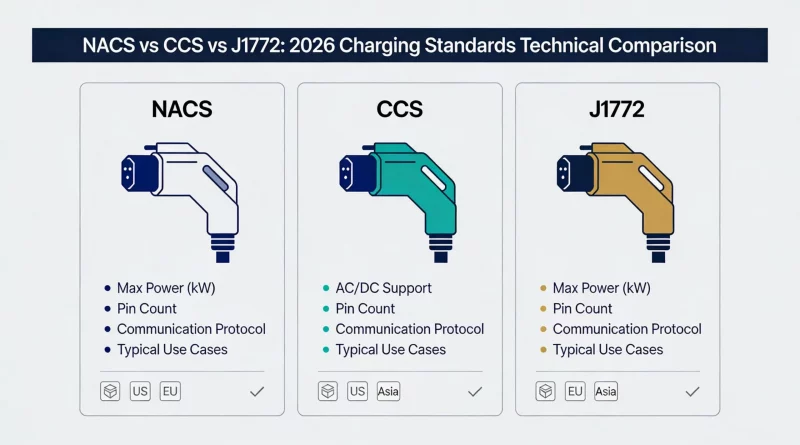
The ‘Charging Wars’ of the early 2020s have officially concluded. As we move through 2026, the dust has settled on a unified North American ecosystem, but for many drivers, the transition period remains a source of confusion. To understand the 2026 charging landscape, one must look at the three primary standards: J1772, CCS1, and the now-dominant SAE J3400 (NACS). Each serves a specific purpose in the current vehicle fleet, and knowing the difference is key to both charging speed and vehicle resale value.
The Victor: SAE J3400 (NACS)
The SAE J3400, originally developed by Tesla as a proprietary connector, is now the North American standard for almost 95% of new electric vehicles sold in 2026. Its primary advantage is its compact, ‘all-in-one’ design. Unlike previous standards that required separate pins for alternating current (AC) and direct current (DC) charging, J3400 utilizes the same pins for both. This results in a connector that is roughly half the size of its competitors while supporting higher power throughput. In 2026, J3400 stations are capable of delivering up to 350kW for passenger vehicles and up to 1MW for heavy-duty applications like the Tesla Semi. Most importantly, J3400 is the first standard to fully integrate the ISO 15118-20 ‘V2G’ (Vehicle-to-Grid) protocol as a mandatory requirement, allowing vehicles to not only draw power but also provide it back to the grid during peak demand.
The Legacy Standard: CCS1 (Combined Charging System)
While J3400 is the future, CCS1 remains the most common high-speed port found on ‘legacy’ EVs manufactured between 2018 and 2024. CCS1 was an evolution of the J1772 plug, adding two massive DC pins at the bottom to allow for fast charging. While robust, the connector is notoriously bulky and prone to mechanical latching issues. In 2026, if you own a CCS1 vehicle, you are likely relying on a ‘NACS-to-CCS’ adapter to access the modern J3400 network. While these adapters are safe, they are often capped at 250kW, meaning a CCS1 vehicle will charge slower at a 2026 Supercharger than a native J3400 vehicle. For buyers looking at the used market, a CCS1 vehicle should be priced significantly lower than a comparable J3400 model due to this long-term convenience gap.
The AC Specialist: J1772 (Type 1)
Finally, we have the SAE J1772, or ‘Type 1’ connector. In 2026, this standard has been largely relegated to Level 2 home charging and older public ‘destination’ chargers found at hotels and shopping malls. J1772 is strictly for AC charging and cannot be used for high-speed DC charging. Because the J3400 port is backward compatible with J1772 signals, every 2026 EV comes with a simple, passive adapter in the trunk. This allows you to plug into any legacy J1772 station. While it only adds about 25-30 miles of range per hour, J1772 remains a critical ‘backup’ standard for overnight charging in areas where the high-speed J3400 infrastructure hasn’t yet reached full density. Understanding this hierarchy—J3400 for speed and future-proofing, CCS1 for legacy DC, and J1772 for slow AC—is the foundation of EV literacy in 2026.