Hydrogen’s Heavy-Duty Pivot: Why Trucks Are Ditching Batteries in 2026
The Hydrogen Renaissance
- The Realization: Physics wins. Batteries are too heavy for Class 8 trucks and heavy towing; Hydrogen offers the payload capacity of diesel.
- The Players: Toyota, Honda, and Kenworth (PACCAR) are launching production FCEV trucks in 2026.
- Refueling: Infrastructure is still the bottleneck, but “Hydrogen Corridors” are opening along major interstates (I-5, I-10).
- Use Case: Ideal for fleets that return to base or drive fixed long-haul routes.
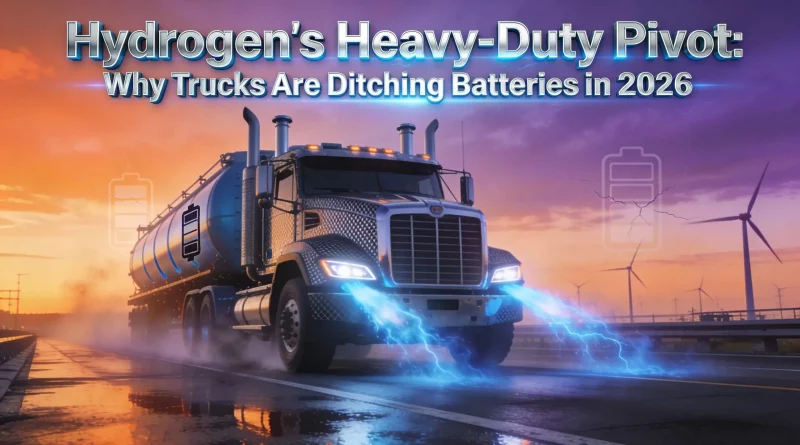
For a decade, Elon Musk called them “Fool Cells.” But in 2026, the joke might be on the battery purists—at least in the heavy-duty sector. While the passenger car market has largely chosen BEV (Battery Electric), the commercial trucking and heavy towing market is pivoting hard toward Hydrogen Fuel Cells (FCEV).
The math is simple: To tow 80,000 lbs for 500 miles, you need a battery so heavy it consumes 30% of your payload capacity. Hydrogen tanks weigh a fraction of that. In 2026, fleet managers are doing the math, and Hydrogen is winning the long-haul war.
Table of Contents
The Tech: FCEV Explained
A Fuel Cell Electric Vehicle (FCEV) is an electric truck. It uses the same electric motors as a BEV. The difference is the energy storage. Instead of a massive battery pack, it carries tanks of compressed hydrogen gas.
The fuel cell stack mixes hydrogen with oxygen from the air to create electricity on the fly, which powers the motors. The only exhaust is pure water. Refueling takes 10-15 minutes, not the 2 hours required to charge a megawatt-class battery.
2026 Hydrogen Truck Releases
- Toyota Hilux FCEV: While currently limited to pilot programs in Europe/Asia, buzz is building for a North American trial. It offers diesel-like range with zero emissions using the Mirai’s fuel cell stack.
- Honda CR-V e:FCEV: A passenger car example that proves the tech works. It features a plug-in battery for city driving and hydrogen for highway trips, offering a unique “dual-fuel” solution built in Ohio.
- Kenworth T680 FCEV: The heavy-duty king. Powered by Toyota’s dual fuel cell modules, this Class 8 truck is now hauling goods out of the Port of Los Angeles, proving the viability of the tech in drayage operations without the financial instability seen in startups like Nikola.

The Station Problem
This is the Achilles heel. In 2026, hydrogen stations are still rare outside of California. However, federal funding has established “Hydrogen Hubs” in Texas and the Midwest. For a consumer, buying an FCEV is risky. For a fleet that installs its own depot pump, it is brilliant.
Hydrogen vs. Diesel for Towing
Hydrogen offers the torque of electric motors (instant pulling power) without the range degradation of batteries. A battery EV might lose 50% range when towing; Hydrogen trucks lose only about 20-30%, similar to diesel.