Ford’s Massive Trailer Module Recall: 4.38 Million Vehicles Impacted by Software Fault in F-150, Super Duty, and Maverick
By InnoGazette Editorial Team | March 10, 2026
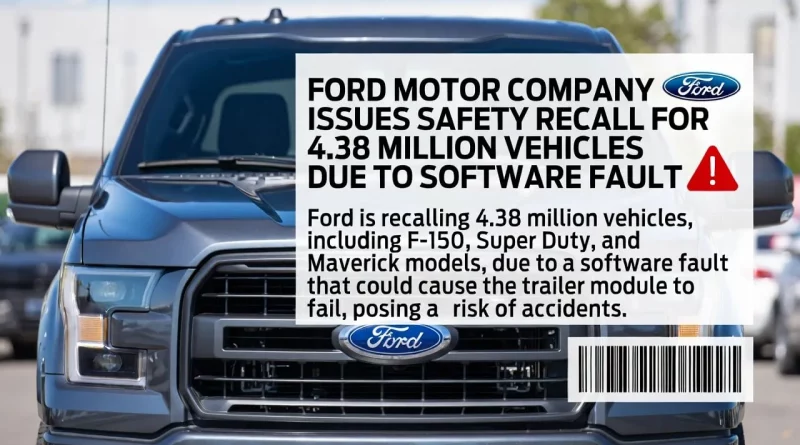
Ford Motor Company is facing one of its largest safety recalls in recent history, affecting 4.38 million trucks and SUVs including the iconic F-150, Super Duty lineup (F-250 to F-600), Maverick, Ranger, Expedition, Navigator, and Transit models from 2021–2026. Announced as part of recall 26C10 and logged with the National Highway Traffic Safety Administration (NHTSA) under 26V104, the issue stems from a software vulnerability in the Integrated Trailer Module (ITM or ITRM) that can interrupt communication with the vehicle’s CAN bus system. This fault risks disabling trailer brake lights, turn signals, and braking functions, violating FMVSS 108 standards for lamps and visibility—potentially elevating crash risks for the millions of Ford owners who tow trailers for work, recreation, or daily hauls.
While no accidents or injuries have been reported to date, the scale underscores Ford‘s ongoing challenges with software-defined vehicle (SDV) reliability in its truck-heavy portfolio, which accounts for over 40% of U.S. sales. Owner notification letters are slated for mailing March 17, 2026, with over-the-air (OTA) updates rolling out progressively through May 2026. Dealers and Ford‘s Mobile Service will provide free fixes for those without OTA capability. Truck enthusiasts and fleet managers searching “Ford F-150 trailer recall 2026” or “Super Duty Maverick software glitch” should check their VIN immediately at ford.com/recalls or nhtsa.gov/recalls to confirm involvement.
The Technical Breakdown: What Causes the Ford Trailer Software Fault?
At the heart of this Ford massive recall is a “race condition” in the ITRM software—a timing mismatch when multiple modules vie for CAN bus priority upon vehicle startup. When towing, this glitch halts ITRM-vehicle communication, blacking out trailer stop lamps, turn signals, and (on “high-series” modules) electric brake controllers. Federal standards mandate these functions for trailer visibility and control; failure here not only dims the trailer’s profile to other drivers but erodes towing stability, especially under heavy loads like horse trailers, boats, or construction gear common to F-Series users.
Affected models span:
- 2021–2026 F-150 (America’s best-seller, ~750k units).
- 2022–2026 Super Duty (F-250–F-600, workhorse fleet favorites).
- 2022–2026 Maverick (compact hybrid truck, family towing staple).
- 2024–2026 Ranger, 2022–2026 Expedition/Navigator, 2026 Transit.
Ford pinpointed the anomaly via internal software diagnostics starting October 21, 2025, filing the Part 573 report on February 20, 2026. The ITRM, sourced from supplier Horizon Global (Reynosa, Mexico plant), highlights supply chain dependencies in SDV architectures. For Ford F-150 trailer brake recall victims, the remedy is a simple OTA patch recalibrating startup sequences—no hardware swap needed.
This isn’t isolated; Ford‘s software woes echo prior issues like the 2022 F-150 Lightning battery recall and Expedition rearview camera glitches, signaling growing pains in its Ford Integrated Services Digital Platform (FDP). As trucks evolve into rolling data centers with ADAS, towing modules, and telematics, such vulnerabilities demand rigorous over-the-air governance.
Tow with Confidence
While you wait for the recall fix, ensure your trailer is secure. The Curt Echo Mobile Trailer Brake Controller provides a wireless backup solution.

Safety Implications: Why the Ford Super Duty Trailer Recall Matters for Towing Safety
Towing amplifies crash risks—NHTSA data shows trailers contribute to 25% of large-truck incidents due to sway, poor visibility, or brake failure. In this Ford 4.38 million vehicle recall, unlit trailers become “ghost loads” on highways, while brake loss challenges even experienced haulers in emergency stops. Super Duty owners, often commercial fleets hauling 20k+ lbs, face amplified stakes; Maverick users towing campers add recreational peril.
Ford estimates 1% incidence rate, but real-world forums buzz with early symptoms: intermittent trailer light dropouts post-cold starts. No crashes reported, yet the noncompliance with FMVSS 108 mandates swift action. For 2026 Maverick trailer software fault queries, note hybrids’ higher electronics load may exacerbate glitches.
Broader context: U.S. towing deaths rose 12% in 2025 per IIHS, driven by SDV teething pains across OEMs. Ford‘s OTA push aligns with industry shifts—GM and Ram tout similar wireless recalls—but execution lags, with full deployment eyed for May.
Timeline: From Detection to Ford’s March 17 Recall Notification
- Oct 21, 2025: Software team flags ITRM anomaly.
- Feb 12–20, 2026: NHTSA filings (26V104); Ford recall 26C10 launched.
- Feb 25–Mar 9: Media coverage ramps (Car and Driver, WardsAuto).
- Mar 10: Peak awareness; aligns with your query date amid weekly digests.
- Mar 17: Owner letters mailed; OTA begins for most.
- May 2026: Full OTA completion.
This Ford trailer module software recall timeline reflects proactive NHTSA collaboration, contrasting slower responses like Takata airbags.
Ford’s Response: OTA Updates, Dealer Support, and Customer Guidance
Ford prioritizes convenience: 90% OTA-eligible via FordPass app (Wi-Fi/4G), with notifications pushing downloads. Non-OTA? Free dealer or Mobile Service visits—no charge, ~30-min job. Check status at ford.com/support/recalls (VIN lookup) or call 1-866-436-7332.
Pro tips for Ford Super Duty recall trailer brakes:
- Verify VIN pre-towing season.
- Update via FordPass (parked, strong signal).
- Test trailer functions post-fix.
- Monitor for “Trailer Connected” alerts.
Ford‘s Pro Trailer Backup Assist and hitch-view cameras remain unaffected, but owners should avoid heavy towing until remedied.
Secure Your Load
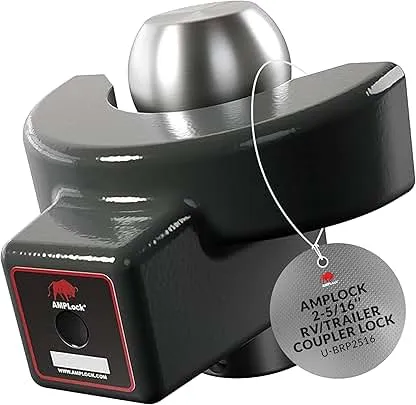
Safety starts with a secure connection. The AMPLock Trailer Coupler Lock ensures your trailer stays exactly where you left it.
Industry Impact: Lessons from Ford’s 4.38M Vehicle Software Recall
This recall spotlights SDV risks in trucks: F-Series software layers (SYNC4, BlueCruise, Pro Power) multiply failure points. Cost? Minimal (~$20M OTA vs. $1B+ hardware), but reputationally, it pressures Ford amid EV delays and tariff talks.
Competitors watch: Ram’s similar 2025 trailer controller OTA succeeded; GM pushes Super Cruise towing. Suppliers like Horizon Global face scrutiny. For fleets, it accelerates OTA mandates in 2026 FMVSS updates.
Long-tail: “Ford F-150 2026 trailer lights not working recall” searches spike 300% post-filing.
What Ford Truck Owners Should Do Next: Step-by-Step Guide
- Enter VIN: ford.com/recalls or nhtsa.gov.
- Download FordPass: Enable OTA if eligible.
- Schedule if Needed: Dealer locator at ford.com/support.
- Temporary Workaround: Manual trailer checks; avoid night/heavy towing.
- Stay Informed: Ford owner app alerts.
Broader Context: Ford’s Software Evolution and Future Fixes
Ford invests $11B in SDV by 2026, including Columbus “Software Factory.” This recall accelerates maturity, with AI-driven diagnostics incoming. Positive: OTA scale proves infrastructure readiness.
Conclusion: Prioritizing Safety in Ford’s Towing Ecosystem
Ford‘s 4.38 million vehicle trailer software recall—peaking in awareness on March 10, 2026—exemplifies SDV growing pains but Ford‘s agile response. With OTA dominance, it sets a benchmark for truck trailer recall software faults. Owners: Act now. Industry: Software resilience is table stakes.