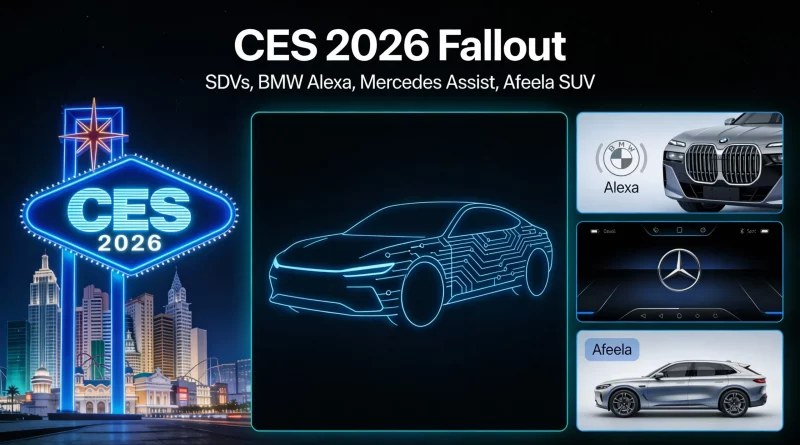
CES 2026 Fallout: Why Software-Defined Vehicles Are the New Standard
Key Takeaways from CES 2026
- The War is Over: Legacy auto has capitulated to Silicon Valley. NVIDIA and Qualcomm now dictate vehicle architecture.
- Hardware is Secondary: 2026 marketing materials mention “Inference Capability” and “TFLOPS” before “Horsepower.”
- The End of the Tier 1 Supplier: OEMs are bringing software in-house to control the user experience.
- The “Living Room” Concept: Sony-Honda Afeela and BMW confirmed that in-car gaming and streaming are primary selling points.
- Zonal Architecture: The new wiring standard makes cars lighter and smarter, but significantly harder to repair.
If you walked the floor at the Las Vegas Convention Center this January, one thing became abundantly clear: the automobile is no longer a machine; it is a high-voltage mobile device. CES 2026 wasn’t defined by 0-60 times, cornering G-force, or towing capacities. It was defined by FLOPS (Floating Point Operations Per Second), inference capabilities, and the finalized, industry-wide shift toward the Software-Defined Vehicle (SDV).
For over a century, automotive progression was measured in cylinders, displacement, and mechanical grip. Today, that era is officially closed. The 2026 Consumer Electronics Show marked the point of no return. Every major manufacturer—from the stalwarts like Toyota, VW Group, and Stellantis to the disruptors like Rivian, Lucid, and the newly aggressive Sony-Honda Mobility—demonstrated that the “Software-Defined Vehicle” is no longer a futuristic concept. It is the absolute standard for any vehicle released this year.
For the average consumer in 2026, this shift is jarring. It fundamentally changes how we buy, maintain, insure, and resell cars. It shifts the value of a vehicle from its mechanical durability to its software support lifecycle. A car with a pristine engine but an obsolete operating system is now a liability. Below, we break down the harsh reality of the SDV landscape following the massive announcements from Las Vegas, and what you need to know before signing a finance contract this year.
Table of Contents
The Battle of the Chips: NVIDIA vs. Qualcomm
In 2023, car buyers asked about miles per gallon. In 2026, savvy buyers are asking, “Who makes the chip?” The most significant news out of CES 2026 was the consolidation of automotive computing power into two primary camps: the NVIDIA Drive Thor ecosystem and the Qualcomm Snapdragon Ride Flex digital chassis.
NVIDIA Drive Thor: Adopted by BYD, Mercedes-Benz, and Land Rover, this system is a beast. It integrates the infotainment, the automated driving, and the driver monitoring into a single system-on-a-chip (SoC) delivering 2,000 TFLOPS of performance. To put that in perspective, that is roughly equivalent to 200 PlayStation 5 consoles strapped to your dashboard. This allows for what Mercedes calls “Unsupervised Learning”—the car’s AI learns your driving habits locally, without needing to constantly ping the cloud.
Qualcomm Snapdragon Ride Flex: The choice of GMC, BMW, and Stellantis. This architecture focuses heavily on efficiency and 5G connectivity. It prioritizes the “Digital Cockpit” experience, ensuring that your screens are as responsive as an iPad Pro. At CES, BMW showcased a “Holodeck” windshield display powered by this chip that overlays navigation data onto the real world with zero latency.
Why You Should Care: These chips are the new “V8 vs. V6.” A car with an older chip (like the ones found in 2024 models) will stop receiving major updates by 2028. A car with a 2026 Thor or Snapdragon chip is future-proofed for at least 8-10 years. When buying a used EV in the future, the chip generation will dictate the price more than the odometer reading.
The New Zonal Architecture Explained
To understand why 2026 cars are different, you have to look under the skin. In the past, a car had 100+ Electronic Control Units (ECUs) scattered around the chassis. There was a dedicated computer for the windows, a computer for the engine, a computer for the seats, and they all talked over a messy, heavy web of copper wires called the CAN bus.
In 2026, that is obsolete. The standard confirmed by major players at CES is “Zonal Architecture.”
Instead of a dedicated computer for the window switch, a central supercomputer controls “zones” of the car (e.g., Front Left Zone, Rear Right Zone). The central brain sends a data packet saying “Roll down window,” and the zone controller executes the power. This reduces wiring harness weight by up to 30%—a massive efficiency gain for EVs—and allows for instant Over-the-Air (OTA) updates because one brain controls everything.
The Pros and Cons for Owners
- Pro: Performance Updates. Your car improves with age. Because the central brain controls the suspension, braking, and infotainment, an OTA update can actually improve ride comfort or stopping distance. We saw this with the Tesla Model 3 Highland in 2024, and now every manufacturer is doing it.
- Con: Repair Complexity. If a Zonal Controller fails, you lose functionality for that entire corner of the car (lights, windows, locks, sensors). These are proprietary, high-cost modules. You cannot simply swap them with a junkyard part because they are cryptographically paired to the central computer.
The 2026 Subscription Model: What Stuck?
Back in 2024, there was an uproar over subscriptions for hardware (like the infamous BMW heated seats saga). The fallout at CES 2026 shows manufacturers listened—mostly. Hardware subscriptions are dead. Software subscriptions, however, are booming.
Manufacturers have realized that consumers will not pay a monthly fee for something that is physically bolted to the car. However, they will pay for dynamic software capabilities. The “Feature on Demand” (FoD) market is projected to hit $14 billion this year. Here is what the pricing landscape looks like for a typical 2026 premium EV:
| Feature Type | Status in 2026 | Avg Cost |
|---|---|---|
| Heated Seats/Steering | Standard (One-time buy) | $0/mo |
| L3 Autonomous Drive | Subscription | $99-$199/mo |
| Performance Boost (EV) | One-time Unlock | $1,500 flat |
| Advanced Navigation/Traffic | Subscription | $10/mo |
| App Store/Gaming | Subscription (Data) | $15/mo |
This “Software as a Service” (SaaS) model is how legacy automakers plan to survive. They aren’t just selling you a car; they are selling you a recurring revenue stream. Be very careful when reading the window sticker in 2026—a feature listed might only be a “trial” that expires in 3 months.
DIY Maintenance in a Software World
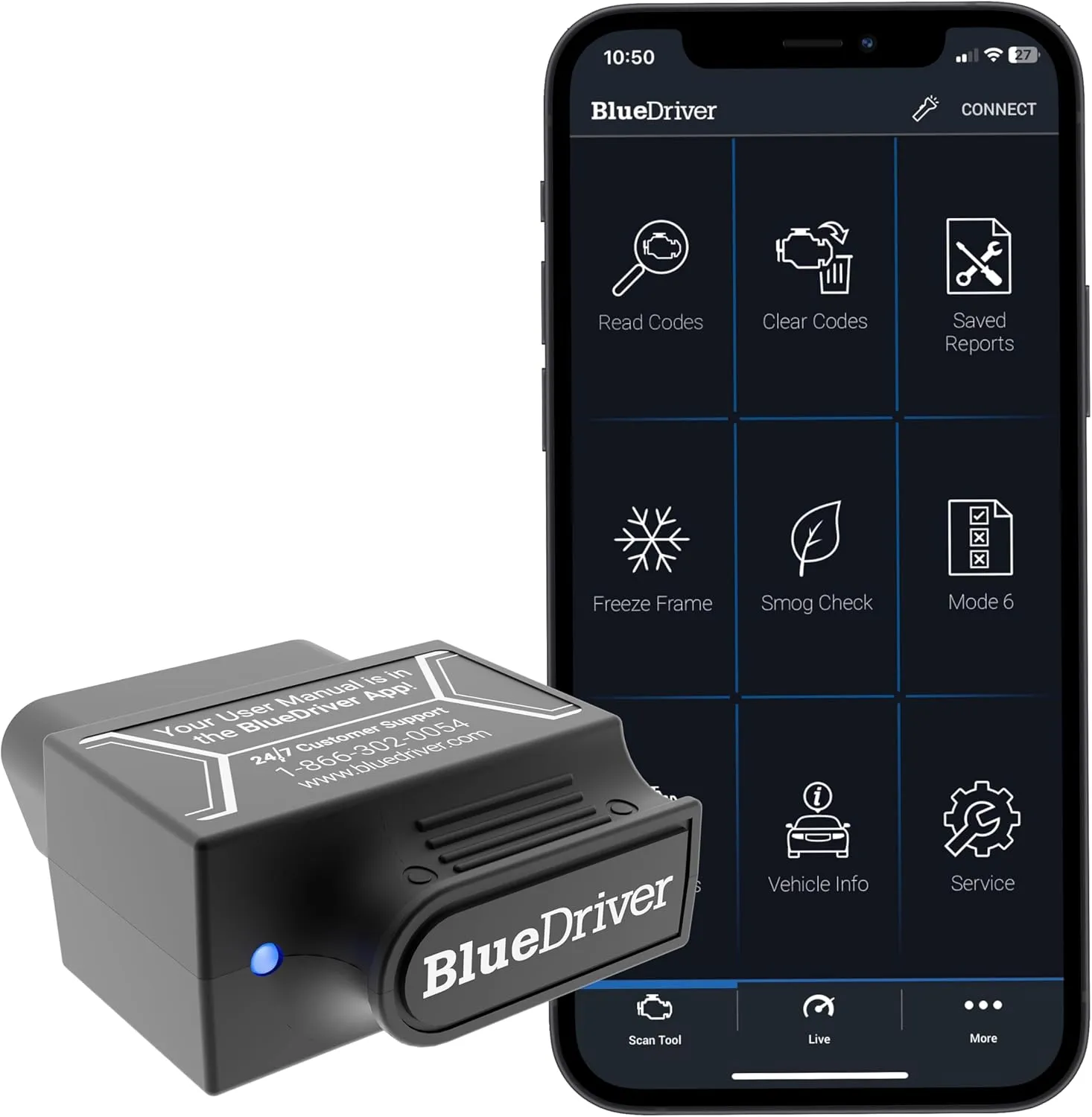
The biggest fear regarding SDVs is the “Right to Repair.” With cars becoming rolling computers, can you still fix them in your driveway? The answer is complex. Mechanical parts (suspension, brakes, tires) remain standard and serviceable. However, sensor calibration and software faults require OBD access that some manufacturers try to lock down.
Fortunately, right-to-repair legislation passed in late 2025 in several key states (California, Massachusetts, New York) has ensured that the OBDII port remains open for diagnostics, even on SDVs. You absolutely need a scanner that can read manufacturer-specific codes, not just generic “Check Engine” lights. In 2026, a “Check Engine” light is more likely to be a “Check Algorithm” light, indicating a conflict between two software modules rather than a physical failure.
Common Mistakes When Buying an SDV in 2026
Buying a car in 2026 is more like buying a high-end laptop than a traditional vehicle. Here are the pitfalls to avoid:
- Ignoring the CPU Specs: Just like buying a computer, ask about the processor. A 2026 car with a 2022-era chip (like an Intel Atom) will lag in two years when new software updates roll out. Look for Qualcomm Snapdragon Ride or NVIDIA Thor integration. If the salesperson doesn’t know the chip, check the spec sheet.
- Assuming “Full Self-Driving” Transfers: Most software licenses are non-transferable on used markets. If you are buying used, verify that the software suite stays with the VIN, not the previous owner’s account. Tesla started this trend, but now Kia and Ford are doing it too.
- Forgetting Data Plans: These cars use massive data for HD mapping and entertainment. Ensure the connectivity plan is affordable. Many OEMs are now charging $20/month for “Premium Connectivity” which is required for remote start and music streaming.
The Car as a Living Room
Perhaps the most consumer-facing update at CES 2026 was the solidification of in-car entertainment. With charging stops still averaging 15-20 minutes, the car is becoming a third living space. Sony-Honda Mobility (Afeela) showcased PS5-level remote play integration, and BMW partnered with major streaming platforms to turn the “Theatre Screen” into a legitimate cinema experience.
This isn’t a gimmick anymore; it’s a core selling point. If you have kids, the ability to run two independent gaming streams in the back seat while charging is a feature worth more than 50 extra horsepower. The interior design of 2026 vehicles reflects this, with lie-flat seats and pivoting screens becoming standard in the premium segment.
Recommended Next Reads
- ADAS in 2026: What Works, What Doesn’t
- Mercedes Drive Assist Pro: How to Test It
- The 2026 EV Charging Landscape