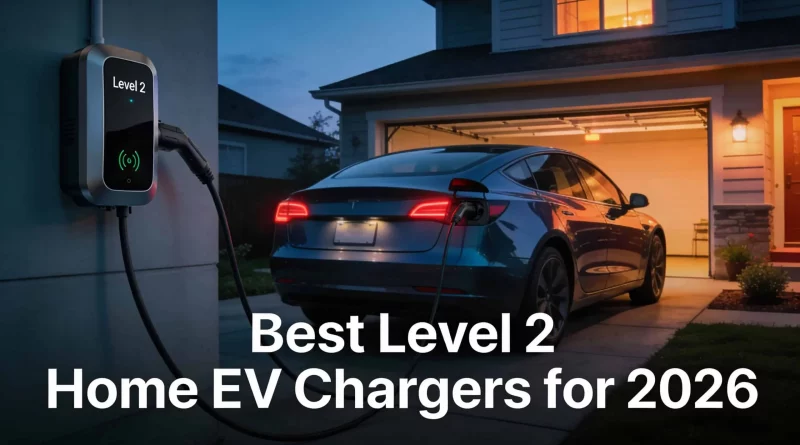
Best Level 2 Home EV Chargers for 2026: V2H and Load Management
Home charging in 2026 is no longer just about delivering electricity to a car; it is about Energy Orchestration. As the electrical grid faces increasing pressure and utility companies transition to mandatory time-of-use (TOU) rates, the ‘best’ home chargers are defined by their ability to integrate with smart home ecosystems, manage bidirectional power, and prevent costly electrical panel upgrades. For the 2026 homeowner, the decision process has moved beyond simple amperage to software-driven performance.
The Standard Shift: Native J3400 (NACS) Hardware
Every charger on our 2026 ‘Best Of’ list features a native SAE J3400 (NACS) handle. While adapters were common in 2024, they are now viewed as a temporary fix that introduces unnecessary heat and resistance during high-amperage sessions. A native J3400 charger ensures that your 2026 vehicle can utilize the full communication protocol of the car, enabling faster handshakes and Plug & Charge convenience at home. Furthermore, cables in 2026 have moved toward liquid-cooled or ultra-flexible composite materials, ensuring that a 48-amp cable is as light and manageable as a 16-amp cable from a decade ago.
Top Performance Picks for 2026
1. Tesla Universal Wall Connector ($600): This remains the benchmark for versatility. Its integrated ‘Magic Dock’ handle houses both a J1772 and J3400 connector, making it the perfect choice for multi-EV households that might have a legacy 2022 Hyundai alongside a new 2026 Ford. Its integration with the Tesla App and Powerwall ecosystem allows for ‘Charge on Solar’—a feature that automatically directs excess solar generation into your car instead of the grid, essentially making your commute carbon-neutral.
2. Wallbox Quasar 3 ($1,200): This is the premier choice for Bidirectional (V2H) charging in 2026. While the hardware cost is higher, the Quasar 3 allows your vehicle to act as a whole-home backup battery. During a power outage, it can draw up to 9.6 kW from your car’s battery to keep your essentials running. In many 2026 utility programs, this hardware also qualifies for ‘Demand Response’ payments, where the utility pays you to stop charging or even discharge energy back to the grid during peak hours, often earning owners $200–$500 per year.
3. Emporia Pro V3 with Load Management ($599): For owners of older homes with 100-amp or 200-amp panels, the Emporia Pro is a technical marvel. It includes a wireless energy monitor that clips into your main breaker panel. If the system detects that you have turned on the dryer, oven, and HVAC simultaneously, the charger automatically throttles the EV’s power draw to prevent a breaker trip. This ‘Dynamic Load Management’ removes the need for expensive $3,000 panel upgrades, making EV ownership accessible to those in older housing stock.
Installation Strategy: Why Hardwiring is the 2026 Standard
In 2026, we strongly recommend hardwired installations over the legacy NEMA 14-50 ‘dryer plug’ approach. While plugs were popular for their portability, they are now capped at 40 amps (9.6 kW) due to revised safety regulations regarding continuous high-draw appliances. Hardwiring your unit to a 60-amp circuit unlocks the full 48-amp (11.5 kW) potential of modern onboard chargers. This increases your charging speed by roughly 20%, which is essential for the larger 100kWh+ battery packs found in 2026 electric SUVs and trucks. When hiring an electrician, ensure they use 6AWG copper wire and provide a certificate of inspection; insurance companies in 2026 have begun requiring this documentation for EV home charging setups to maintain fire coverage.