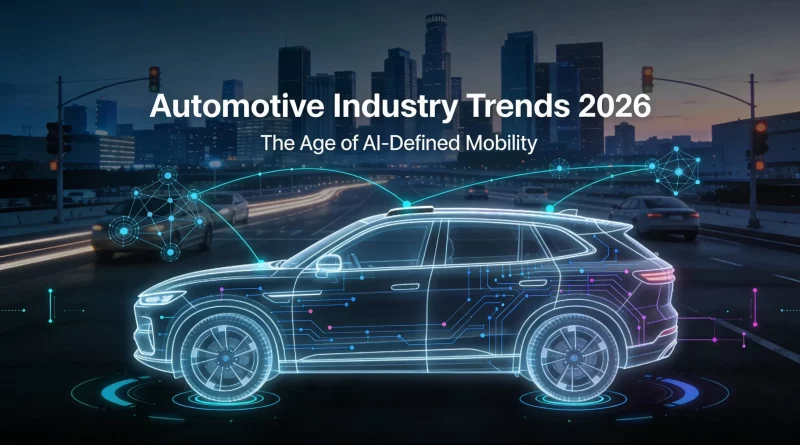
Automotive Industry Trends 2026: The Age of AI-Defined Mobility
Following the 2026 Consumer Electronics Show (CES), the automotive industry has reached a point of no return. We have officially moved beyond the era of the Software-Defined Vehicle (SDV) and into the era of AI-Defined Mobility. This shift represents the largest transformation since the transition from horse to engine. This 700-word analysis explores the three dominant trends that will define the next decade of transportation.
Trend 1: The Rise of Zonal Compute Architecture
For decades, cars were built with hundreds of individual Electronic Control Units (ECUs). In 2026, this ‘distributed’ model has been replaced by Zonal Compute Architecture. By utilizing high-performance central computers, manufacturers have reduced vehicle weight and complexity significantly. This not only increases EV range but enables a ‘Universal Digital Twin’ for every vehicle. With zonal architecture, an automaker can update the suspension dampening logic or torque vectoring instantly via the cloud, making the car a dynamic asset that improves over time.
Trend 2: Generative AI and Multi-Modal Cockpits
The 2026 cockpit is a personalized ‘Third Space.’ With on-device Large Language Models (LLMs), your car no longer just follows voice commands; it understands context. Using internal sensors, the AI can detect driver fatigue or stress and adjust the cabin atmosphere or driving mode accordingly. This ‘Generative Cabin’ also serves as a productivity hub, allowing occupants to handle complex tasks through natural conversation while the vehicle handles Level 3 autonomous driving on highway corridors.
Trend 3: V2X Monetization and Energy Arbitrage
In 2026, the vehicle is a core revenue driver through data. As Vehicle-to-Everything (V2X) communication becomes standard, cars are constantly talking to the grid and infrastructure. This allows for Energy Arbitrage, where EV owners act as distributed energy providers, selling battery capacity back to the utility during peak hours. Some estimates suggest a 2026 EV owner can generate enough income to offset 40% of their monthly financing cost, fundamentally changing the economics of car ownership forever.