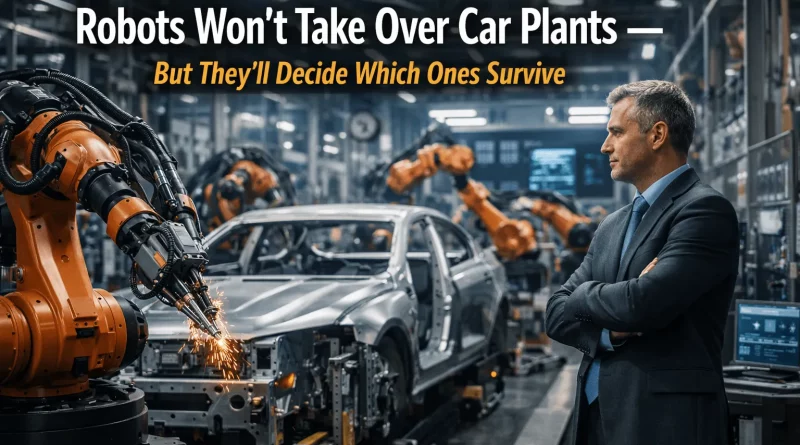
Robots Won’t Take Over Car Plants But They’ll Decide Which Ones Survive
By InnoGazette Editorial Team | March 3, 2026
Through most of the EV hype cycle, attention has focused on batteries, software, and charging networks. Quietly in the background, another megatrend has been building: automation inside the factories themselves. A new March 2, 2026 consulting report projects that robotics and smart-factory solutions in automotive manufacturing will grow at roughly 12 15% a year through 2032 fast enough to more than double the size of this market segment over the decade.
That kind of growth doesn t happen because robots are cool. It happens because the economics of building cars, trucks, and SUVs are under pressure from every direction: multi-energy platforms, flat volumes in mature markets, rising labor and energy costs, and political pushes to reshore production. Automation has become the must-have tool for OEMs who want plants to survive into the 2030s, not just a nice-to-have capex line item.
Why Automation Is Suddenly the Star of the Strategy Deck
Automotive has been automated for decades welding robots and paint booths were old news even in the 1990s. What s changed is what factories are being asked to do in 2026 and beyond.
The multi-energy squeeze
A modern plant is no longer asked to build just one type of vehicle for a long, stable life cycle. Instead, the same site might need to assemble:
- Traditional ICE models for price-sensitive or infrastructure-limited markets.
- Hybrids and PHEVs to hit CO? and fuel-economy rules.
- BEVs for compliance, incentives, and brand positioning.
All of that might sit on related architectures. That means more variants on the same line, more frequent mid-cycle updates, and far less tolerance for shutting a line down for weeks every time something changes. Automation especially modular robotics and software-defined control systems lets OEMs reconfigure cells and flows faster, so they can adjust the mix of ICE, hybrid, and BEV without turning every change into a major construction project.
Costs, margins, and flat volumes
Global light-vehicle volumes in mature markets aren t surging. At best, they re stable with some year-to-year noise. Yet capital needs are growing: battery plants, new platforms, software teams, charging partnerships. In that environment, the only way to defend margins is to lower the cost and variability of building each vehicle.
Automation does that by improving labor productivity, cutting scrap and rework through better process control, and reducing unplanned downtime via predictive maintenance. A 12 15% annual growth rate in automation spend is the financial reflection of a strategic reality: OEMs see no path to long-term profitability without more flexible, more automated plants.
Automate Your Garage
Just like the factory floor, your home garage can be smarter. The Chamberlain MyQ Smart Garage Hub lets you control and monitor your garage door from anywhere.

Inside the Smart Factory : What s Actually Changing
Smart factory can sound buzzwordy. On the ground, it comes down to a stack of technologies that increasingly work together instead of as isolated islands.
Robots are getting eyes and brains
Classic articulated robots still dominate welding and heavy handling. The change is that they re increasingly paired with vision systems that allow them to detect misalignment and adjust on the fly, and AI models that help classify weld quality or surface defects in real time. Instead of running the same pre-programmed path regardless of part variation, a modern cell can sense and adapt. That boosts quality and cuts rework, especially in areas like battery pack assembly and body-in-white.
Cobots move into final assembly
Collaborative robots (cobots) are moving from pilot projects into mainstream use. They re particularly useful for repetitive, ergonomically tough tasks such as lifting seats or glass, and precision fastening and sealant application where human oversight is still valuable. Rather than fence off a huge zone, cobots share space with operators. That makes them ideal for final assembly lines where full hard automation is too rigid but traditional manual labor is too slow or physically demanding.
Mobile robots take over material flow
Automated guided vehicles (AGVs) and autonomous mobile robots (AMRs) increasingly handle material movement: bringing parts from warehouse to line just in time, and shuttling battery packs or subassemblies between stations. This reduces forklift traffic, accidents, and manual material-handling labor, and it makes it easier to support many model variants on the same line without chaos in the aisles.
Digital twins and simulation reduce changeover pain
Before a line is changed, many automakers now build a digital twin of the plant or at least of key lines and cells. They simulate new models, different takt times, and alternative robot programs. This lets them test changes virtually before committing to physical rework, cutting down on trial-and-error downtime and helping justify automation investments with more confidence.
Data, MES, and predictive maintenance
The glue tying all of this together is software. Manufacturing execution systems (MES) track each vehicle and component through the plant. Sensors feed data into analytics platforms that monitor cycle times, scrap, downtime, and energy use. Predictive maintenance tools flag when a robot, conveyor, or press is trending toward failure, so repairs can be scheduled during planned pauses.
What This Looks Like for Workers
It s easy to talk about automation in terms of capex and CAGR. It s harder, but more important, to ask what it means for the people working inside these plants.
Fewer backbreaking jobs, more tech-heavy roles: Done well, automation takes over dangerous and physically punishing tasks high-heat welding, heavy repetitive lifting and creates new roles around robot programming, cell supervision, quality analytics, and maintenance. The line worker standing with a torque wrench for eight hours becomes a cell operator overseeing a mixed human-robot station.
The need for serious reskilling: This isn t automatic. Moving from manual tasks to supervising automated systems requires training in basic robotics and control logic, and comfort with digital dashboards. Support from management and, often, unions is crucial to make reskilling part of the plant s culture.
Jobs saved, jobs changed, some jobs gone: At a plant level, automation is often what keeps a facility viable in a high-wage country. A factory that becomes cost-competitive again is less likely to be closed or moved. But within that plant, some roles disappear or shrink, and some jobs shift from hands-on to supervisory.
Upgrade Your Toolset
Modern cars require modern tools. Whether you’re a DIYer or a pro, the BlueDriver OBDII Scan Tool gives you factory-level diagnostics on your smartphone.

Why This Matters for EVs, Hybrids, and ICE Alike
One of the most important points for readers is that factory automation is powertrain-agnostic. Whether a plant builds a V6 pickup, a hybrid crossover, or a battery-electric sedan, it faces similar pressures to manage complexity, maintain quality, and hit cost targets. EV-only plants do have unique needs battery pack assembly, high-voltage safety but the same automation toolkit applies.
For hybrid and ICE plants that have gained a second lease on life due to slower-than-expected EV adoption, automation is often the price of that reprieve. If a company decides to keep making a popular ICE or hybrid model into the 2030s, it s usually contingent on automating enough of the process to keep costs in line with global competitors.
Regional Case Studies: Where Automation Will Hit Hardest
North America: Reshoring and “friend-shoring” policies encourage local production. To make U.S. plants competitive with lower-wage regions, OEMs lean heavily on robotics. New and retooled plants are designed as automation-first facilities.
Europe: High energy and labor costs force high automation. Flagship plants in Germany and France are being transformed into showcase smart factories to keep high-skill industrial jobs onshore.
China: Shifting from pure volume to smarter automation. Domestic automation vendors are growing rapidly, aiming to replace foreign equipment with homegrown robots and AI solutions.
OEM-by-OEM: Who s Ahead?
- Leaders: Treat automation as a core strategic pillar. They have a coherent global roadmap and invest aggressively in in-house talent.
- Fast Followers: Move quickly to copy and adapt proven technologies from leaders, focusing spend on high-impact plants.
- Laggards: Have fragmented automation landscapes and treat it as episodic capex. These companies are most at risk.
What This Means for the Next Decade
Automation will be the deciding factor in which plants stay open during the next big restructuring wave. When OEMs choose where to build future platforms, they ll favor sites that combine skilled labor, good logistics, and high automation readiness.
For the industry, the projected 12 15% CAGR in automotive factory automation spend is not just a financial forecast. It s a statement that, behind the scenes, the real race isn t only about who sells the most EVs or has the flashiest in-car software. It s also about who can build complex vehicles, on flexible lines, at globally competitive cost.