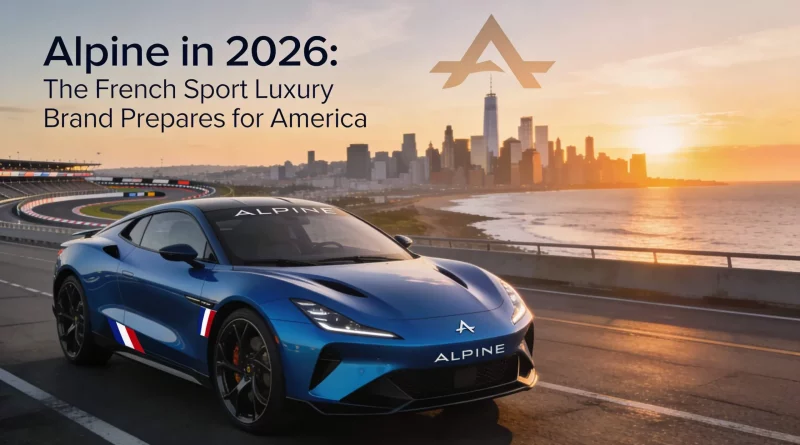
The French Sport Luxury Brand Alpine, Prepares for America
TL;DR: The French Revolution is Coming
- The A290: The electric hot hatch based on the Renault 5 is the “It” car of Europe for 2026, featuring an “Overtake” button derived from F1.
- The A390: The “Sport Fastback” (don’t call it an SUV) enters production late this year, targeting the Porsche Macan EV.
- US Invasion: Alpine has confirmed a 2027 entry into North America, likely bypassing traditional dealers for a direct-to-consumer model.
- The Tech: Alpine is betting on torque vectoring and lightweight construction (“The French Lotus”) rather than just raw horsepower.
For decades, American automotive enthusiasts have looked across the Atlantic with a specific kind of jealousy. The Europeans always kept the best “forbidden fruit” for themselves. We missed out on the Peugeot 205 GTI, the Renault Clio V6, and the original A110. But in 2026, the walls are finally breaking down.
Alpine (pronounced Al-peen), Renault’s high-performance arm, is no longer content with being a niche player hidden in the French Alps. Under the aggressive leadership of CEO Philippe Krief, the brand is executing a massive global expansion strategy that puts Porsche directly in its crosshairs. The goal is audacious: to transform from a single-model manufacturer selling 3,000 cars a year into a global luxury powerhouse selling 100,000.
This isn’t just about launching new models; it’s about brand survival. In the age of the Software-Defined Vehicle (SDV), niche brands die if they cannot scale. Alpine is building a “Dream Garage” of electric vehicles that promise to retain the soul of driving in a silent era. In this comprehensive report, we dissect the 2026 roadmap, the engineering behind the new A290 and A390, and the concrete plans for the 2027 US invasion.
Table of Contents
Context: Who is Alpine?
To understand why 2026 is such a pivotal year, you have to understand where Alpine came from. Founded in 1955 by Jean Rédélé, a Dieppe garage proprietor, the brand became famous for using Renault engines in lightweight, fiberglass bodies. They dominated rallying in the 1970s.
After being dormant for decades, Renault revived the brand in 2017 with the new A110—a mid-engine sports car that many journalists declared was “better than a Porsche Cayman.” However, the A110 is gas-powered, and its lifecycle ends in 2026 due to new European cybersecurity regulations (GSR2) that the old platform cannot meet. This year, 2026, is the transition point. The gas cars die, and the “Dream Garage” of EVs is born.
The A290: The Electric Hot Hatch We Want
While the A390 is the global profit-maker, the Alpine A290 is the soul of the brand. Launched in Europe in late 2025 and hitting full stride in 2026, it is based on the reborn electric Renault 5.
Specs that Matter
- Power: 220 hp / 221 lb-ft torque.
- 0-60 mph: 6.4 seconds.
- Weight: 3,260 lbs (Heavy for a hatch, but light for an EV).
- Battery: 52 kWh.
On paper, those numbers look pedestrian compared to a Tesla Model 3 Performance. But Alpine isn’t chasing 0-60 times. They are chasing smiles. The A290 features a wider track than the standard Renault 5 (by 60mm), hydraulic bump stops borrowed from rally cars to soak up curbs, and a bespoke subframe.
The “Overtake” Button
The steering wheel features a red button labeled “OV” (Overtake). Inspired by Formula 1 KERS systems, pressing this button delivers 100% of the motor’s available torque and power for 10 seconds, regardless of what drive mode you are in. It effectively gamifies the driving experience. It takes 30 seconds to recharge the boost, adding a strategic element to passing on a backroad.

The A390: The Electric “Sport Fastback”
In January 2026, the “Beta” (_β) designation was officially dropped as the A390 moved into pre-production. This is the car designed to conquer America. Alpine refuses to call it an SUV. They call it a “Sport Fastback.”
Built on the AmpR Medium platform (shared with the Nissan Ariya but heavily modified), the A390 targets the Porsche Macan EV and the Tesla Model Y Performance.
Active Torque Vectoring
The A390 features a tri-motor setup: one motor on the front axle and two independent motors on the rear axle. This allows for genuine active torque vectoring. Unlike a mechanical differential which reacts to slip, the A390’s computer can overdrive the outside rear wheel in a corner, physically pushing the nose of the car into the turn. This eliminates understeer, a common plague of heavy electric SUVs. Alpine claims the A390 will have the agility of the A110, despite weighing 4,800 lbs.
The Interior: “Snowflake” Carbon
Alpine is distinguishing itself through materials. The interior features “Snowflake” recycled carbon fiber, which has a random, crystalline pattern rather than a woven look. The seats, designed by Sabelt, recline into a “Zero Gravity” position derived from NASA research, intended to reduce back strain while waiting at charging stations.
Alpine in America: The 2027 Plan
The rumors are no longer just rumors. In January 2026, Alpine CEO Philippe Krief dropped the strongest hint yet. The brand is preparing a 2027 North American Launch. Here is the strategy:
- The Lineup: They will likely skip the small A290 hatch (which is too small for US tastes) and launch with two vehicles: The A390 Crossover and a larger, yet-to-be-revealed electric SUV (potentially called the A490) designed specifically for the American market to compete with the Porsche Cayenne.
- The Sales Model: Alpine wants to avoid the dealership wars. They are exploring a “Direct-to-Consumer” sales model similar to Lucid and Rivian, or a “Boutique” agency model where you order online and pick up at a specific Alpine Studio.
- AutoNation Partnership: Rumors suggest Alpine is negotiating with AutoNation to handle the service and parts logistics, solving the biggest hurdle for new entrants (repair networks).
Engineering the “French Lotus”
Alpine’s philosophy has always been lightness. The A110 weighs just 2,400 lbs. An EV battery weighs 1,000 lbs on its own. How do they reconcile this?
They are focusing on perceived lightness. By using four-wheel steering (4Control), the rear wheels turn opposite the fronts at low speeds, making the wheelbase feel shorter. This allows the car to pivot around a hairpin like a go-kart. Alpine is also one of the few manufacturers investing in “feel”—they have calibrated the regenerative braking to feel like engine compression braking, giving the driver a reference point for speed entering a corner.