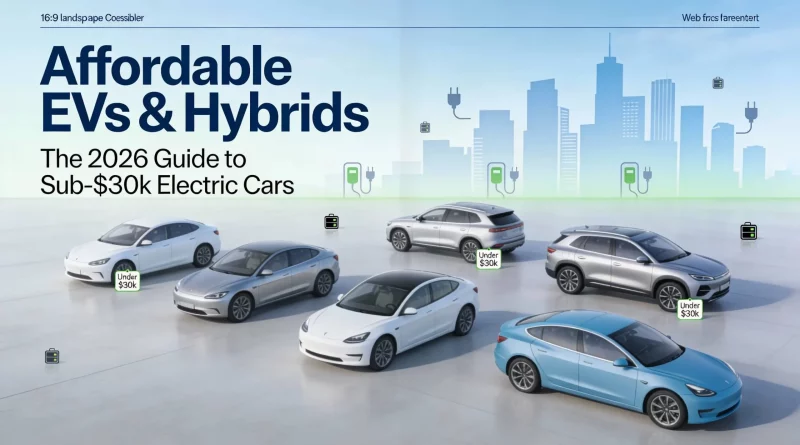
Affordable EVs & Hybrids: The 2026 Guide to Sub-$30k Electric Cars
TL;DR: The Sub-$30k Revolution
- Chevy Bolt (Ultium): It’s back. 260 miles range, 150kW charging, starts under $29k.
- VW ID.2all: The “Electric Golf.” Front-wheel drive, spacious, and aiming for $27,000.
- Toyota RAV4 (2027): Not an EV, but the hybrid redesign will likely be the best-selling electrified vehicle in the world.
- Tax Credits: The Bolt qualifies; the VW and Toyota depend on assembly location.
While the rich fight over $200,000 electric Jaguars, the real war is happening at the bottom of the market. 2026 is officially the year of the “Affordable EV.” After years of inflated prices, high interest rates, and “market adjustments,” manufacturers have realized they cannot sustain themselves on luxury trucks alone.
They need volume. And to get volume, they need to hit the magic number: $30,000. This guide analyzes the three most important affordable cars launching in the 2026-2027 window: The reborn Chevrolet Bolt, the Volkswagen ID.2, and the next-gen Toyota RAV4.
Table of Contents
Chevrolet Bolt: The Ultium Redemption
The original Bolt was a good car with a bad battery (literally). The 2026 Bolt is a complete clean-sheet design built on GM’s Ultium platform. It shares its technology with the Equinox EV but in a smaller, lighter package.
- Range: Estimated 260 miles (EPA).
- Charging: This is the big upgrade. It now charges at 150kW (up from 50kW). You can add 100 miles of range in about 20 minutes.
- Port: Native NACS (Tesla) port. No adapter needed.
With a starting price of $28,995 (before tax credits), it effectively becomes a $21,500 car for eligible buyers. GM has confirmed it will be built in Kansas alongside the Equinox EV, ensuring it qualifies for the full $7,500 federal tax credit.
Volkswagen ID.2: The People’s Car
Volkswagen is going back to its roots. The ID.2all concept previewed a car that looks like a Golf, has the interior space of a Golf, but runs on electrons. Production begins in 2026. It uses a new “MEB Entry” platform which is Front-Wheel Drive (unlike the RWD ID.4). This simplifies the packaging and lowers the weight. The interior brings back physical buttons for the volume and climate control—a direct response to customer hatred of the ID.4’s touch sliders.
Toyota RAV4: Hybrid Domination
While not a full EV, the 2027 Toyota RAV4 deserves mention here because it will outsell both the Bolt and ID.2 combined. Leaks confirm it will be Hybrid-Only (dropping the gas engine). The “Prime” PHEV version is targeting 55 miles of electric range. For many affordable car buyers, this is the safer bet: EV for the commute, gas for the road trip, and Toyota reliability forever.
LFP Batteries: The Secret to Low Cost
How are they hitting these prices? The secret is Lithium Iron Phosphate (LFP) batteries. Unlike traditional NMC batteries (Nickel Manganese Cobalt), LFP batteries use cheaper iron. They are heavier and have slightly less range, but they are:
- Cheaper: About 20% less to manufacture.
- Durable: They can be charged to 100% daily without degradation (NMC prefers 80%).
- Safe: Much lower risk of thermal runaway (fire).
Both the 2026 Bolt and the base-model Rivian R2 use LFP tech to hit their low starting prices.