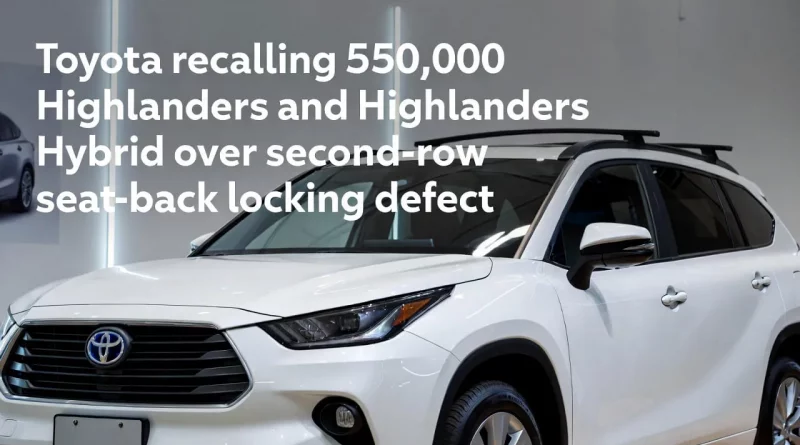
Toyota Recalls 550,000 Highlander and Highlander Hybrid SUVs Over Second-Row Seat-Back Locking Defect
By InnoGazette Editorial Team | March 13, 2026
Toyota has initiated a major safety recall affecting approximately 550,007 Highlander and Highlander Hybrid SUVs in the United States due to a defect in the second-row seat-back locking mechanism that could fail to secure properly after adjustment, increasing the risk of injury in a crash. The recall covers specific 2021–2024 model-year Highlander and Highlander Hybrid vehicles and is being conducted in cooperation with the National Highway Traffic Safety Administration (NHTSA) under Toyota recall numbers 26TB06 and 26TA06.
According to recall documentation filed with NHTSA, a design or manufacturing issue in the recliner assemblies can prevent the internal teeth from fully engaging when a second-row seat back is repositioned, leaving the seat back partially or fully unsecured. In a high?speed collision, an unlocked seat back may fail to restrain occupants properly, significantly raising the risk of serious injury. For owners searching long?tail queries such as “2021–2024 Toyota Highlander second-row seat recall” or “Toyota Highlander Hybrid seat back may not lock recall 2026”, this campaign is now one of the most consequential Toyota SUV safety actions of the decade.
Scope of the Toyota Highlander Seat-Back Recall
Toyota’s filings and multiple news outlets outline the scale and composition of the affected population clearly.
- Total vehicles affected: Approximately 550,007 SUVs in the U.S. market.
- Models included: Highlander (gas) and Highlander Hybrid – selected 2021–2024 model years.
- Breakdown by powertrain (NHTSA/coverage figures): ~420,771 Highlander, ~129,236 Highlander Hybrid.
NHTSA’s recall notice and Toyota’s communications emphasize that not every Highlander from those model years is included; rather, a defined production subset linked to a specific recliner component design is affected. Owners are urged to verify individual VIN status via Toyota.com/recall or NHTSA’s recall lookup tool.
The Defect: How Second-Row Seat Backs Can Fail to Lock
At the core of this Toyota Highlander second-row seat recall is a problem with the seat-back recliner assemblies used in the second row.
Defect description
The second?row seat backs use recliner mechanisms with toothed gears and springs that allow the seat back to tilt and then lock into the chosen position. Due to a design or supplier?level change, the recliner teeth may not fully engage when the seat back is readjusted. This can result in the seat back appearing to be set but actually not being locked into position.
NHTSA’s notice warns that a seat back that has not been secured in a locked position may fail to properly restrain occupants, increasing the risk of injury in the event of a crash at higher speeds. Multiple reports underline that the defect is mechanical, not software?related, which means an over?the?air patch is not possible and a physical repair at a dealership is required.
Supplier involvement
The defective recliner technology was associated with Toyota Boshoku Indiana, which supplies interior components for the Highlander family. NHTSA notes that a design change at the supplier level in 2023–2024 affected how the recliner’s return spring and locking spring interact, potentially preventing the locking teeth from fully engaging. Toyota’s internal reviews in late 2023 identified abnormal behavior during assembly?plant inspections and triggered a more in?depth investigation.
Secure Your Cargo
Safety inside the cabin is paramount. While you wait for the fix, ensure loose items are secured with the Fortem Car Trunk Organizer.

Safety Risk: Why This Highlander Recall Is Critical
While the recall does not involve engine, braking, or steering systems, the impact on occupant protection is serious.
- In a frontal or rear collision, a properly locked seat back is a structural component of the occupant restraint system, keeping the torso in the correct position relative to the seat belt and airbag.
- If the seat back is partially or fully unlocked, it may tilt unexpectedly during a crash, allowing the occupant to move excessively and significantly increasing the risk of head, neck, and spinal injuries.
- This concern is heightened for second?row passengers, including children in booster seats, who depend on the integrity of the seat structure behind them.
Regulators and news outlets consistently characterize the hazard as an elevated injury risk at higher speeds rather than a minor comfort issue. For families who chose the Highlander specifically for its safety reputation, this second-row seat-back locking issue warrants prompt attention.
How Toyota Discovered the Problem and Decided on the Recall
Toyota’s recall history and NHTSA filings provide a clear timeline of how the defect surfaced and escalated into a full campaign.
Discovery and investigation
October 2023 – Toyota identifies unusual behavior in second?row seat backs during internal inspection at an assembly plant.
Mid–2024 – Further investigation reveals that the seat supplier implemented a design change to the recliner components that had not been fully documented or flagged in normal change?control processes. Toyota engineering teams, working with the supplier and NHTSA, perform simulations and physical tests to understand under what conditions the teeth might fail to fully lock.
Decision to recall
Toyota ultimately decided to issue a voluntary safety recall after concluding that the seat-back locking issue could compromise occupant protection during a crash and that affected vehicles were already on the road in significant numbers. The company’s formal decision to recall was made in February 2026, with public communications and NHTSA notices emerging in early–mid March.
Recall Remedy: How Toyota Will Fix the Highlander Seat-Back Issue
Toyota’s remedy centers on replacing springs within the recliner assembly for the affected second-row seat backs.
Repair details
Dealers will inspect the second?row seat recliner assemblies and replace the return springs with improved parts designed to ensure that the locking teeth fully engage after adjustment. The repair will be performed free of charge for all owners, in line with standard safety recall practice.
Because the issue is hardware-based and located inside the seat mechanism, owners must bring their vehicles to a Toyota dealer—there is no remote or software?only solution. Toyota and NHTSA indicate that the repair should be relatively straightforward, but final visit length will depend on dealer workload and whether multiple seat backs must be addressed.
Owner notifications and timing
Toyota is planning to mail owner notification letters beginning on or after April 20, 2026. Owners can check recall status before receiving a letter by using their VIN at Toyota.com/recall or NHTSA’s recall lookup at nhtsa.gov/recalls.
Toyota’s customer service line (1?800?331?4331) is available for recall-specific questions, references 26TB06 / 26TA06. For searchers of “Toyota 26TB06 26TA06 recall details”, these codes are the official internal identifiers that dealers and NHTSA will use.
How This Recall Compares to Other Recent Toyota Safety Actions
The Highlander seat-back recall arrives on the heels of other Toyota safety campaigns, underscoring the broader quality and compliance environment. In February 2026, Toyota recalled approximately 141,000 Prius and Prius Prime vehicles due to rear doors that could unexpectedly open while driving under certain conditions.
Toyota continues to manage a portfolio of older recalls involving fuel pumps, airbag controllers, and hybrid system faults, but the Highlander second-row seat recall stands out due to its scale and the family?oriented nature of the vehicle. The company’s official statements acknowledge the seriousness of the defect and emphasize its commitment to customer safety while working closely with NHTSA to ensure fast and comprehensive remediation.
What Highlander and Highlander Hybrid Owners Should Do Now
If you own or manage a 2021–2024 Toyota Highlander or Highlander Hybrid, there are immediate steps you should take to address this seat-back safety recall.
- Check if your VIN is affected: Visit Toyota.com/recall and enter your 17-character VIN. Or go to nhtsa.gov/recalls and use the federal recall lookup tool. If your vehicle is covered under the Highlander seat-back locking recall, the site will display relevant campaign information and next steps.
- Monitor for the notification letter: Even if you confirm participation online, wait for or proactively request your official Toyota recall letter, which will include a description of the defect and risk, instructions for scheduling service, and clarification that the repair is free of charge. Letters are expected to be mailed from late April 2026 onward.
- Schedule a dealer appointment promptly: Because the defect affects crash protection, owners should treat the recall as a priority, especially if the second row is frequently used by children or other passengers. Contact your local Toyota dealer to book a recall appointment.
- Be cautious with seat-back adjustments in the meantime: Until the repair is completed, owners may wish to minimize unnecessary reclining/adjusting of the second?row seat backs and ensure occupants are properly belted and that child seats are installed per manufacturer guidelines.
Keep Your SUV Clean
While your Highlander is in for service, keep it looking new. The Chemical Guys Arsenal Builder Kit is perfect for SUVs.

Implications for Toyota’s Safety Reputation and SUV Segment
The Toyota Highlander is one of the best?selling three?row SUVs in North America, widely marketed as a family?oriented, safety?focused vehicle. A recall of over half a million units for a seat-back locking defect is therefore significant both reputationally and commercially. The recall underscores the importance of supplier quality management and robust validation of even seemingly minor interior components. It also reflects how modern safety expectations extend beyond airbags and brakes to include seat structures, headrests, and child?restraint compatibility.
For competitors in the midsize SUV space, this event may influence marketing strategies around safety features and recall responsiveness. That said, Toyota’s proactive cooperation with NHTSA and clear remedy plan—free repairs, defined codes (26TB06/26TA06), and transparent communication—align with industry best practices and are likely to temper long?term brand damage if execution is smooth.
Conclusion: Key Takeaways for Industry Stakeholders and Consumers
For industry analysts, regulators, and safety advocates evaluating “Toyota Highlander recall 550,000 seat backs March 2026”, several themes emerge:
- Scale and specificity: The recall targets a large, clearly defined population within a crucial SUV nameplate.
- Mechanical, not electronic: In contrast to many recent software?driven recalls, this issue reminds the industry that mechanical design changes at suppliers can still have far?reaching consequences.
- Regulatory vigilance: NHTSA’s tracking and Toyota’s prompt filing demonstrate a robust process for addressing defects before large numbers of injuries occur.
- Owner responsibility: Ultimately, the effectiveness of any recall depends on owners scheduling and completing repairs. Awareness and follow?through remain critical.
For consumers, the message is straightforward: if you own a 2021–2024 Highlander or Highlander Hybrid, check your VIN, watch for your notification letter, and arrange the free repair as soon as possible.