U.S. Auto Market 2026: Fewer Sales, Faster Sells, and a Buyer Affordability Wall
By InnoGazette Editorial Team | March 3, 2026
Early 2026 feels weird if you live in the U.S. car market every day. Showrooms aren t empty like the chip-shortage era, but they re not buzzing like 2021 2023 either. Sales volumes are down versus last year, yet the cars people actually want are disappearing from lots faster. Dealers are cautiously optimistic. Shoppers, not so much many are walking away because the math on payment calculators simply doesn t work for them.
This is the story of a market caught between healthy inventory and brutal affordability, where days to sell is improving even as total sales sag.
The Scoreboard: 2026 Starts Softer Than 2025
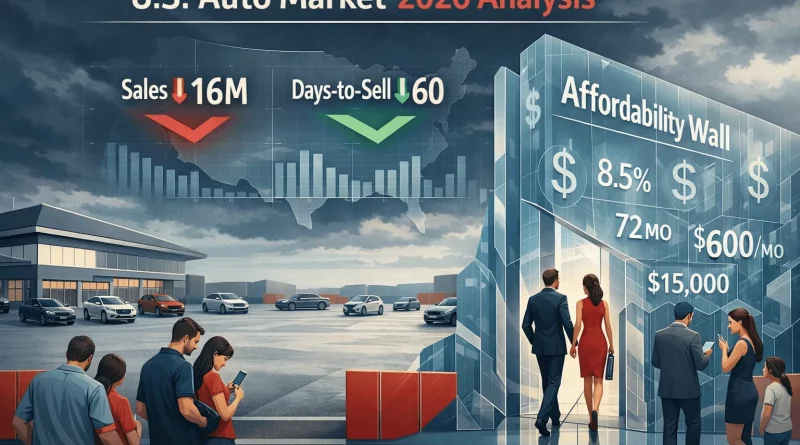
Through February 2026, U.S. light-vehicle sales are running behind the pace of early 2025 in pure volume terms. Annualized, the market is tracking in the mid?15 million SAAR zone, respectable but below the snap-back peaks some forecasters once hoped for.
Behind that headline, two things are happening at the same time:
- Overall transaction volumes are lower than a year ago.
- The average time it takes to sell a desirable vehicle has shrunk especially for in-demand trims and body styles.
In other words: fewer people are buying, but when they do, they snap up the right product quickly. That s the fewer sales, faster sells paradox.
Inventory: From Starvation to Acceptable Lean
During the worst of the chip crisis, U.S. dealers were operating on 30 40 days supply (or less in hot segments), a far cry from the historical 60 70 days that made the business feel comfortable. By early 2026, inventory has recovered to something closer to lean but livable.
A few patterns stand out on the ground:
- Core models are back: Compact and midsize crossovers, full-size trucks, and mainstream SUVs are once again consistently present on lots.
- Less panic ordering: Dealers aren t begging for anything they can get. They re more willing to say no to slow-selling configurations.
- Trim-level barbell: You see plenty of base-ish units spec d for price-conscious buyers and plenty of high-content, high-margin models; the middle is thinner.
This healthier inventory is one reason the days to sell metric is improving: shoppers who can afford to buy are more likely to find what they want color, trim, drivetrain without waiting months.
Affordability: The Hard Ceiling on Demand
If there s one word that defines the 2026 U.S. auto market, it s affordability.
Three forces are working against the average buyer:
- Sticker prices that never really came back down: MSRP levels ratcheted up during the inflation years have largely stuck. Many mainstream SUVs and trucks now live in the $45,000 $60,000 band.
- Higher interest rates than the pre?COVID era: Financing rates remain well above the cheap-credit era of the 2010s. A 72? or 84?month loan at today s APR transforms even a $35,000 car into a painful monthly payment.
- Stretched household budgets: Insurance, maintenance, and fuel are all more expensive. Many buyers are getting squeezed by cost of living, limiting tolerance for a $700 $900 car payment.
Dealers will tell you they see it every day: traffic isn t dead, but more deals fall apart in the F&I office when real numbers hit the screen. That s why the market can simultaneously report fewer sales and fast turn for the right units.
Know Your Vehicle’s Value
In a tough market, knowledge is power. Use the BlueDriver OBDII Scan Tool to assess the health of any used car before you buy or trade in.

Who s Still Selling Fast and Why
Not every segment is suffering equally. Broadly, three types of product are doing well early in 2026:
1. Right-size crossovers at the right price
Compact and midsize crossovers that hit the sweet spot of monthly payment, fuel efficiency, and features tend to sell quickly. A well-equipped but not overloaded 2?row SUV that can stay in the high $30Ks to low $40Ks remains the heartbeat of the market.
2. Hybrids and PHEVs that don t overshoot on price
Full BEVs may be flattening in share, but hybrids and plug?in hybrids that deliver tangible fuel savings without a huge price premium turn fast. Models like the Toyota RAV4 Hybrid and Honda CR-V Hybrid are often on short supply because they appeal directly to people watching monthly fuel spend.
3. Desirable trims of full-size trucks
The truck market is no longer the free-for-all it was in 2021, but there s still strong demand for well-priced, well-equipped half-ton pickups. Fleet and commercial buyers, in particular, are less rate-sensitive than retail customers.
EVs: Plateauing Rather Than Exploding
One of the quiet undercurrents of early 2026 is that pure EVs are no longer the growth rocket many automakers projected. Instead, BEV market share looks more like a plateau. Retail EV share is hovering in the mid-single digits.
Dealers report that interest is high, but conversion is lower, often due to price, charging anxiety, or concerns about resale value. This is not an EV collapse it s more of a reality check. The next wave of buyers is more pragmatic and more payment-sensitive, and many of them are choosing hybrids or PHEVs instead of BEVs.
Dealer Sentiment: Spring Optimism, EV Pessimism
Dealer surveys heading into Q2 2026 paint a nuanced picture:
- Overall sentiment about the next 90 days is cautiously positive. Spring is traditionally a stronger selling season.
- Sentiment around EVs specifically has turned sharply negative. Many franchised dealers say they re stuck between factory pressure to push EV volume and customer hesitancy.
Maintain Your Hybrid
Hybrids are the heroes of 2026. Keep yours running efficiently with regular fuel system maintenance using BG 44K.

Brand and Segment Winners
Early 2026 doesn t treat all brands equally. The winners tend to be those with a strong hybrid story and competitive monthly payments.
Who s Best Positioned:
- Toyota / Lexus: Deep hybrid bench gives them exactly what the market wants.
- Honda / Acura: CR?V and Accord hybrids hit the value zone.
- The right Detroit products: Full-size trucks and body-on-frame SUVs still sell quickly to commercial and rural buyers.
Product Planning: From All-EV Dreams to Multi-Energy Reality
If you sat in on OEM product-planning meetings in 2021 2022, you would have heard a lot of EV-only future rhetoric. In early 2026, the tune is very different. BEV growth has slowed to a crawl in many mass segments, while hybrids and PHEVs are now the expansion segment. ICE is no longer a dirty word; it s framed as part of a multi-energy strategy.
Conclusion
2026 is shaping up not as a crash, but as a normalization under financial pressure: people still need vehicles, but they re picky, price-sensitive, and wary of overcommitting. For the average buyer, the wait and see approach to EVs and the buy smart hybrid or used now strategy is the rational path.