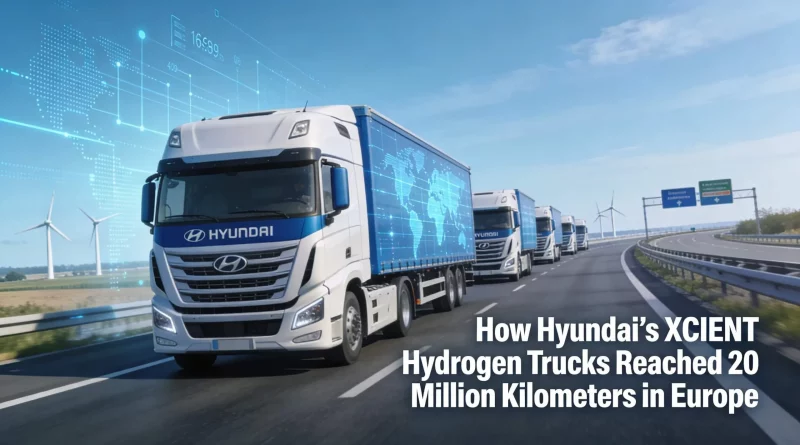
How Hyundai’s XCIENT Hydrogen Trucks Reached 20 Million Kilometers in Europe
TL;DR: The Hydrogen Milestone
- The Record: Hyundai’s XCIENT fleet has surpassed 20 million cumulative kilometers in Europe as of Feb 2026.
- The Proof: This validates durability in real-world Alpine winters and urban heat, proving the tech is ready for scale.
- The Strategy: Operations have expanded beyond Switzerland into Germany, France, and the Netherlands.
- The Future: Data from these 20M km allows for accurate TCO (Total Cost of Ownership) modeling vs. Diesel.
Hydrogen fuel cell trucking has just passed a major credibility test in real world operations. Hyundai Motors XCIENT Fuel Cell heavy duty truck fleet has surpassed 20 million kilometers of cumulative driving in Europe, proving that zero emission long-haul road freight is no longer a theoretical pilot, but a workable reality across multiple markets and use cases.
For fleet operators, policymakers, and logistics customers under pressure to decarbonize, this milestone is a powerful signal: hydrogen fuel cell trucks are moving beyond early demonstration projects into commercial, scalable operations. It transforms the conversation from does the technology work? to how do we scale the infrastructure?
Most automotive milestones are marketing fluff a million units sold, a new lap record. But 20 million kilometers of commercial operation is different. It represents millions of hours of uptime, thousands of refueling cycles, and countless deliveries made on time. It means the trucks didn’t just sit in a lab; they hauled Swiss chocolate over the Alps in February and delivered German auto parts in the heat of July.
Table of Contents
Why 20 Million Kilometers Matters
The headline number 20 million kilometers matters less by itself and more for what it proves about hydrogen fuel cell trucking in actual commercial operations. It is not a lab test; it is a large scale durability trial conducted on Europe’s roads.
Key facts from Hyundai’s latest announcement include:
- More than 165 XCIENT Fuel Cell trucks are now in commercial operation globally.
- The fleet operates in diverse climates, from the freezing Alpine winters of Switzerland to the humid summers of Southern France.
- Trucks serve varied roles: regional distribution, heavy haulage, and specialty transport.
This data set is invaluable. Unlike Battery Electric Vehicles (BEVs), which degrade predictably based on cycles, Fuel Cells are chemical reactors. Their longevity is determined by air purity, thermal management, and humidity control. Surviving 20 million kilometers proves that Hyundai’s intake filters can handle dusty construction sites and their thermal management can handle 12% grades with a full 40-ton load.
Durability & Uptime Data
Heavy duty trucks are capital intensive assets that live or die on uptime. A diesel truck runs 20 hours a day. If a hydrogen truck requires 4 hours of maintenance for every 10 hours of driving, it is useless to a logistics company. The XCIENT fleets ability to accumulate 20 million kilometers indicates that the fuel cell stacks and driveline components can handle sustained high mileage use without rapid degradation.
Fleet managers often ask, “”Do the stacks degrade?”” Early data suggests Hyundai’s stacks are exceeding their 30,000-hour operational targets. By comparison, a diesel engine usually needs a major overhaul at 1 million kilometers. If the Fuel Cell stack can last 5-7 years before refurbishment, the TCO equation begins to look very attractive compared to the volatility of diesel prices.
Garmin dezl OTR710 Truck Navigator
Driving alternative fuel trucks requires careful route planning. Hydrogen trucks are often banned from specific tunnels and bridges due to hazmat regulations regarding compressed gas. The Garmin OTR710 allows you to input your truck’s profile (including fuel type) to route you safely around restrictions, ensuring you don’t get stuck at a tunnel entrance.
The Engineering: Dual-Stack Power
The “”how”” is just as important as the “”how many.”” The XCIENT is a purpose built hydrogen fuel cell electric truck designed for demanding heavy duty duty cycles. It is not a diesel truck with an engine swap; the entire chassis is engineered around the hydrogen tanks.
The Heart of the Beast: The XCIENT uses a dual-mounted fuel cell system. It combines two 90kW stacks for a total continuous output of 180kW. This electricity is fed into a 72 kWh high-voltage battery (acting as a buffer) and then to a 350kW electric motor. This architecture allows the truck to maintain speed up 6% grades fully loaded a feat that often overheats pure battery electric trucks.
- Hydrogen Storage: Seven high pressure tanks sit behind the cab, holding approximately 31kg of hydrogen at 350 bar.
- Refuelling Time: 8 to 20 minutes. This is critical. A battery truck with this range would need 90 minutes on a megawatt charger. The XCIENT refuels while the driver takes a coffee break.
- Range: Real world range of 400+ km per fill. This makes it viable for regional distribution where trucks return to a depot, or “”hub-to-hub”” transport.
The Hydrogen Ecosystem
Hyundai didn’t just build a truck; they helped build the gas stations. The 20 million km milestone was reached by expanding into key European markets:
- Switzerland: The flagship market. Operators use green hydrogen produced from hydropower.
- Germany: Supported by federal funding, Germany now hosts a cluster of stations enabling cross-border runs.
- France & Netherlands: Major ports like Rotterdam utilize these trucks for drayage, moving containers inland without emissions.
The Pay-Per-Use Model
Perhaps the most innovative aspect of the XCIENT program isn’t the truck, but the business model. Hyundai realized that fleets were terrified of the upfront cost (a hydrogen truck costs 3x a diesel truck). To solve this, they partnered with H2 Energy to create Hyundai Hydrogen Mobility (HHM).
How it works: Fleets do not buy the truck. They pay a “”Pay-Per-Use”” fee. This fee covers:
- The lease of the truck.
- The Hydrogen fuel.
- All maintenance and insurance.
This removes the risk from the operator. If the stack fails, Hyundai fixes it. If hydrogen prices spike, the contract protects the fleet. This “”Truck-as-a-Service”” model is the primary reason Hyundai hit 20 million km while competitors are still running pilot programs.
AMPLock Heavy Duty Trailer Lock
Valuable zero-emission freight needs protection. Whether you are hauling consumer goods through Germany or industrial supplies in the US, cargo security is paramount. The AMPLock is the toughest lock on the market, ensuring your trailer stays connected to your truck, not someone else’s.