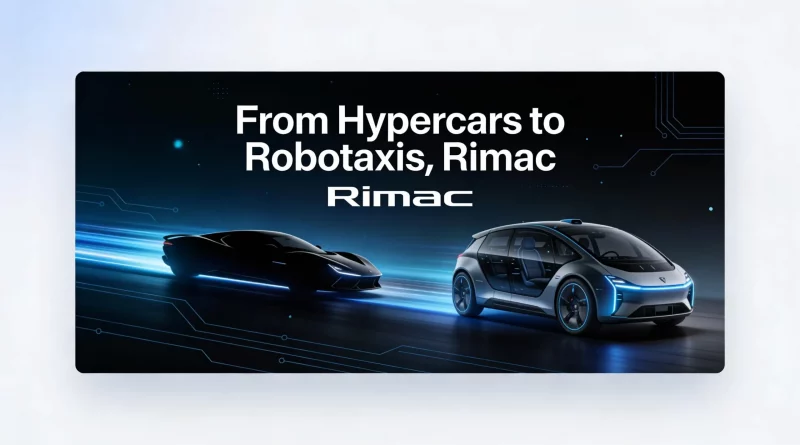
From Hypercars to Robotaxis, Rimac
TL;DR: The Pivot to Autonomy
- Project Verne: Rimac’s fully autonomous robotaxi pilot begins in Zagreb this year. It’s a luxury 2-seater with no steering wheel.
- The Nevera: Production is winding down, but a hardcore “Nevera R” track variant keeps the brand on the Nürburgring leaderboards.
- The Tech: Rimac is using Mobileye Drive systems combined with their own high-voltage battery tech to power the AI compute stack.
- The Future: Rimac Technology is now supplying batteries to BMW for the Neue Klasse, solidifying their role as a Tier 1 supplier.
In the rarefied air of the hypercar market, Rimac stands alone. The Croatian electric wizard proved EVs could be faster than Formula 1 cars with the Nevera. Having shattered 23 performance records in a single day, CEO Mate Rimac announced that the company was done chasing 0-60 times. He has achieved peak speed.
In 2026, the focus shifts to something entirely different: Project Verne. This is a massive pivot for a company known for 2,000 horsepower monsters. Rimac is betting that the ultimate luxury isn’t driving fast—it’s not driving at all. In this report, we break down the Verne project, the Nevera’s final lap, and what it means for the future of the brand.
Table of Contents
Project Verne: The Robotaxi Explained
Named after Jules Verne, this is a fully autonomous robotaxi designed for urban luxury. Unlike the utilitarian, bus-like Tesla Cybercab, the Verne is a sleek two-seater coupe. It has no steering wheel and no pedals. The interior is designed to feel like a living room, with a massive screen spanning the dashboard and seats that recline fully.
The pilot program launches in Zagreb, Croatia later this year, with expansion to Manchester (UK) and Munich (Germany) planned for 2027.
The Mothership: Rimac isn’t just building a car; they are building an ecosystem. The cars return to a central depot called the “Mothership” to charge, clean, and repair themselves automatically. This ensures the fleet is always pristine, solving the “dirty Uber” problem.
Nevera R: The Track Monster
Is the hypercar dead? Not quite. While the focus is on Verne, Rimac continues to produce the Nevera R, a lighter, sharper track variant. By removing comfort features and adding active aero, the R model shaves 0.1 seconds off the 0-60 time (now 1.74s) and improves cornering grip to 2.5G.
However, Mate Rimac has hinted that the next hypercar might not be purely electric. He has experimented with diesel-electric nanoturbines and hydrogen, suggesting that the “Era of the Heavy Battery” might be over for performance cars.
Why Battery Tech Matters for AI
Why is a battery company building robots? Because AI computers consume massive amounts of power. The computing stack in a Level 4 autonomous vehicle (cameras, LiDAR, NPU) can consume 2-3 kW of power constantly. This reduces EV range by 15-20%.
Rimac’s expertise in high-discharge battery cooling systems makes them uniquely qualified to solve this. They are building battery packs that can cool the supercomputer in the trunk while simultaneously powering the wheels, without overheating in gridlocked city traffic.
The BMW Partnership
Rimac Technology (the supplier arm of the company) has secured its biggest win yet: A partnership with BMW. Rimac will supply high-voltage battery packs for the upcoming “Neue Klasse” EVs launching in late 2026. This transforms Rimac from a niche hypercar builder into a Tier 1 automotive supplier, ensuring the company’s financial stability for decades.