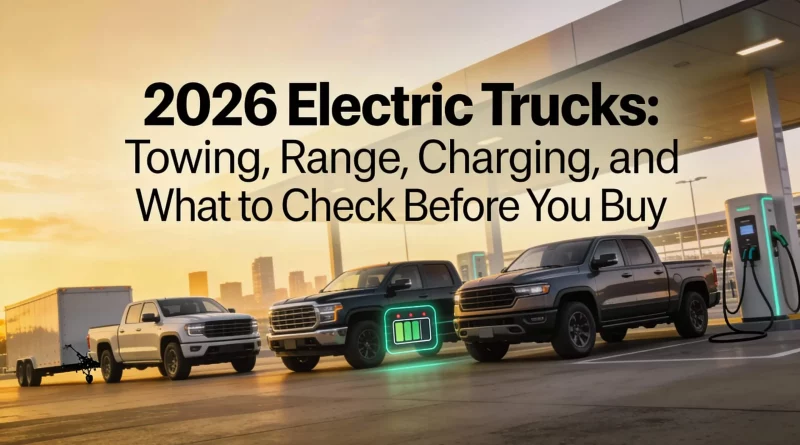
2026 Electric Trucks: Towing, Range, and the Heavy-Duty Buyer’s Checklist
The year 2026 marks the arrival of the ‘Second Generation’ of electric pickups. While early models were largely experimental, 2026 electric trucks are built for high-duty cycles, featuring 800V architectures and integrated V2X (Vehicle-to-Everything) capabilities. However, a truck is not a sedan; the physics of towing and payload create unique challenges for electrification. This 700-word guide provides the essential checklist for anyone moving from a diesel or gas truck to a 2026 electric workhorse.
The Towing Reality: Managing the ‘Range Penalty’
The most searched term in this segment is electric truck towing range, and for good reason. In 2026, towing a 7,000lb trailer still results in a 40–50% reduction in total driving range. While battery energy density has improved, the aerodynamic drag of a trailer remains a constant. The ‘smart’ 2026 truck buyer looks for vehicles with Active Range Estimation software that accounts for trailer weight and tongue load in real-time. If you frequently tow long distances, you must prioritize trucks with a 150kWh+ battery pack and J3400 native ports located on the front fender or rear corner to ensure you can use Tesla’s newer ‘pull-through’ Supercharger stalls without unhitching your trailer.
🛻 Essential Truck Accessories
- Boost Highway Range: Soft Tri-Fold Tonneau Covers (Reduces Drag)
- Safe Towing: Wireless Trailer TPMS Systems
Charging Infrastructure for the 2026 Worksite
Home charging for a truck is a different tier of electrical work. Because 2026 truck batteries are nearly double the size of car batteries, a standard 40-amp charger is often insufficient for an overnight ’empty-to-full’ cycle. We recommend a hardwired 80-amp Level 2 station on a 100-amp circuit. This allows you to utilize the dual-onboard chargers found in many 2026 pickups, delivering up to 19.2kW. Additionally, the 2026 buyer should value V2H (Vehicle-to-Home) and V2L (Vehicle-to-Load) features. Your truck is essentially a massive mobile power bank; 2026 models from Ford, GM, and Rivian can power a professional worksite—including saws, compressors, and chargers—for three full days without needing a recharge, effectively replacing noisy, gas-powered job-site generators.
Payload, Tires, and Thermal Management
In 2026, payload is the silent range killer. While a truck may be rated for 2,000lbs of payload, carrying that weight daily creates rolling resistance that impacts efficiency. Pay close attention to the OE Tire Selection. Many 2026 trucks come with low-rolling-resistance tires designed for range; swapping these for aggressive ‘All-Terrain’ tires can immediately slash your range by 10%. Furthermore, ensure your truck features a High-Output Heat Pump and liquid-cooled battery thermal management. Trucks work harder and generate more heat than cars; without robust thermal management, you will see significant ‘thermal throttling’—where the car slows down your fast-charging speed to protect the battery—during hot summer workdays.
Pre-Purchase Checklist for 2026 Trucks
Before signing the contract, ask the dealer for the ‘Towing Power Curve.’ You want to know how the battery maintains voltage under sustained high-amp draw. Verify the ISO 15118-20 compatibility for seamless Plug & Charge. Finally, run a VIN check via the 2026 Recall Protocol to ensure the battery’s software-defined safety patches are current. An electric truck in 2026 is a superior tool for 90% of buyers, provided you buy for the 10% of days when you are pushing its limits.