2026 Spy Shots & Rumors: How to Read Automotive Leaks Like an Expert
In 2026, the ‘Spy Shot’ industry has become a high-stakes digital game. With the rise of Generative AI and hyper-realistic renderings, the ability to distinguish between a genuine factory prototype and a fan-made ‘hoax’ is a critical skill for any automotive enthusiast or journalist. This 700-word guide pulls back the curtain on how manufacturers hide their 2026 models in plain sight and how you can spot the ‘tells’ that reveal a car’s true identity.
The Science of Modern Camouflage: More Than Just Swirls
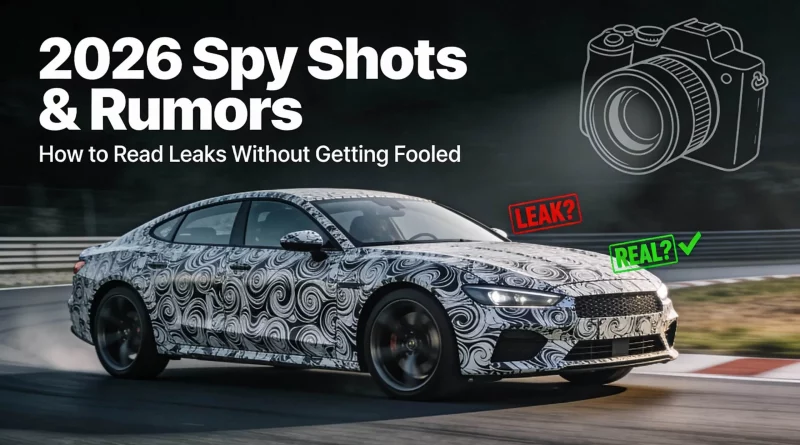
When you see a 2026 prototype covered in black-and-white patterns, you are looking at Dazzle Camouflage. This isn’t meant to make the car invisible; it’s designed to break up the vehicle’s lines and ‘crease signatures.’ In 2026, engineers also use ‘False Body Panels’—plastic or foam blocks hidden under the wrap that change the silhouette of the car, making a sleek sedan look like a bulky crossover.
📸 While You Wait for the 2026 Models…
- Maximize Trade-In Value: Meguiar’s Complete Car Care Kit
- Catch Leaks on the Road: 4K Dash Cams (VIOFO / Garmin)
To see through the camo, ignore the overall shape and look at the Hard Points: the location of the door handles, the placement of the charging port, and the distance between the front axle and the dashboard (dash-to-axle ratio). These mechanical hard points are almost impossible to fake and give you the best clue about the vehicle’s underlying platform.
The ‘AI Leak’ Era: Spotting the Hoax
2026 has seen a surge in Generative AI Leaks. These are images created by AI that look like ‘leaked’ factory CAD drawings or low-resolution spy shots. To verify a rumor, you must look for ‘Physical Logic Errors.’ AI often struggles with realistic tire tread patterns, the exact placement of legal safety markers (like side reflectors), or the reflection of light on the ground. A real 2026 spy shot will almost always feature Testing Equipment: look for ‘Piezometric sensors’ taped to the wheels or ‘Aero-probes’ mounted on the roof. If the car looks ‘too perfect’ or is in a location that a manufacturer wouldn’t use for testing (like a suburban driveway), it is likely a digital fabrication.
Reading the Signals: Regulatory and Supplier Leaks
Often, the best ‘spy shots’ aren’t photos at all; they are data. In 2026, savvy readers look at EPA/NHTSA filings and Import/Export manifests. When a manufacturer like Tesla or Ford prepares a new model, they must register the VIN patterns and crash-test prototypes months in advance. Similarly, supplier rumors—such as a battery manufacturer announcing a new 800V line for a ‘North American OEM’—often confirm the specs of a car long before the camouflage comes off. If a rumor about a 2026 model doesn’t have a corresponding regulatory trail, treat it with extreme skepticism.
Ethical Reporting: Signal vs. Noise
Finally, we must address the ethics of the ‘Rumor Mill.’ In 2026, a single unverified tweet can tank a company’s stock or mislead thousands of buyers into waiting for a car that doesn’t exist. Our framework for 2026 coverage is simple: Confirmed means a press release is in hand; Reported means two independent sources with a track record; Rumor is everything else. When you are reading about ‘2027 Spy Shots’ or ‘2026 Redesigns,’ always ask if the outlet is providing context (like potential J3400 integration) or just hunting for clicks. By understanding the ‘physics of camouflage’ and the ‘logic of data,’ you can become a more informed participant in the 2026 automotive conversation.