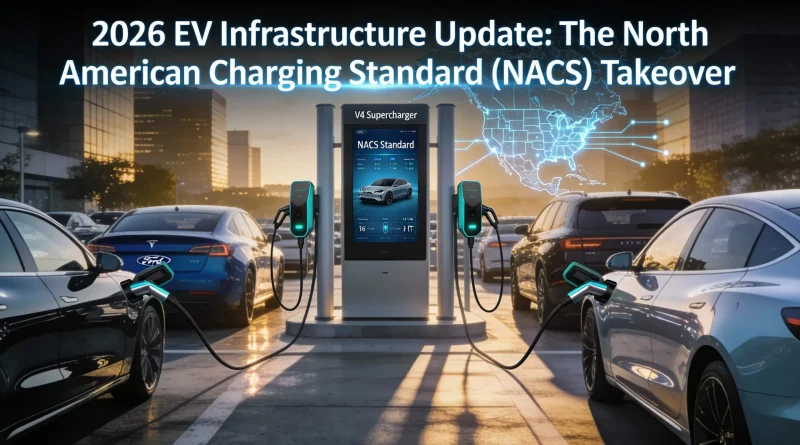
2026 EV Infrastructure Update: The North American Charging Standard (NACS) Takeover
Charging in 2026
- NACS is King: Ford, GM, Rivian, Volvo, and Polestar now ship with native NACS ports on all 2026 models.
- CCS is Fading: Electrify America and EVgo have retrofitted 70% of stations with NACS cables.
- Adapters: If you drive a 2024/2025 model, you still need your J3400 adapter. Don’t lose it; they are backordered.
- Reliability Up: Uptime has improved significantly as Tesla’s tech becomes the baseline for the industry.
- Plug & Charge: ISO 15118 support is now widespread, meaning you rarely need an app to start charging.
Remember the “Range Anxiety” of 2023? In 2026, it has largely been replaced by “Charger Congestion,” but at least the plugs work. The consolidation of the North American charging network under the NACS (North American Charging Standard, now SAE J3400) is effectively complete.
The era of fragmented apps, broken credit card readers, and heavy CCS cables is ending. Today, a F-150 Lightning can pull up to a Tesla Supercharger and plug in seamlessly. However, the transition isn’t without its quirks. Here is the complete landscape of EV infrastructure in 2026.
Native NACS vs. Adapters
If you bought a new EV in the 2026 model year, congratulations: you likely have a native NACS port. This means no dongles, no adapters, and a lighter, easier-to-handle cable. This was the vision set forth by Tesla in 2022, and it has finally materialized across the industry.
However, millions of EVs on the road (2018-2025) still use CCS. For these drivers, the “Adapter Lifestyle” is the norm. The supply chain issues for adapters that plagued 2024 are largely resolved, but quality matters. Stick to OEM (Ford/GM/Tesla) or UL-certified adapters. Cheap knockoffs from overseas have been known to overheat during 250kW charging sessions, causing the station to throttle speeds to safety levels.
The “Cable Length” Issue
One lingering issue in 2026 is cable length. Older V3 Superchargers were designed for Teslas, which have the port on the rear-left. Non-Tesla EVs often have ports on the front-left or front-right. This forces drivers to park awkwardly or take up two spots. Tesla’s V4 Superchargers (now about 30% of the network) have longer cables to solve this, but at older stations, parking etiquette is still a source of tension. Extension cables exist, but they are heavy, expensive ($300+), and reduce charging speed due to resistance.
What Happened to CCS Stations?
They aren’t gone, but they are changing. Networks like Electrify America and EVgo have pivoted. Instead of ripping out chargers, they are retrofitting cables. Most stations now feature a “dual-head” setup (one CCS, one NACS). This ensures backward compatibility while serving the new wave of NACS vehicles.
However, pure CCS stations are becoming rare in new installations. If you rely solely on CCS, plan your trips carefully, as maintenance on legacy CCS-only plugs is becoming a lower priority for charging networks. The “Magic Dock” program (where the adapter is built into the station) has largely been paused in favor of native NACS cables.
Charging While Towing
The 2026 infrastructure has finally started addressing the towing crowd. New “Pull-Through” charging stations are appearing at Buc-ee’s and Pilot/Flying J travel centers. This allows Cybertruck, Silverado EV, and F-150 Lightning owners to charge without unhitching their trailers. If you are towing, filter your navigation apps (like PlugShare or Apple Maps) for “Trailer Friendly” spots to avoid blocking traffic.